




UW Students Launch AI Browser Meteor Through Y Combinator
3 min read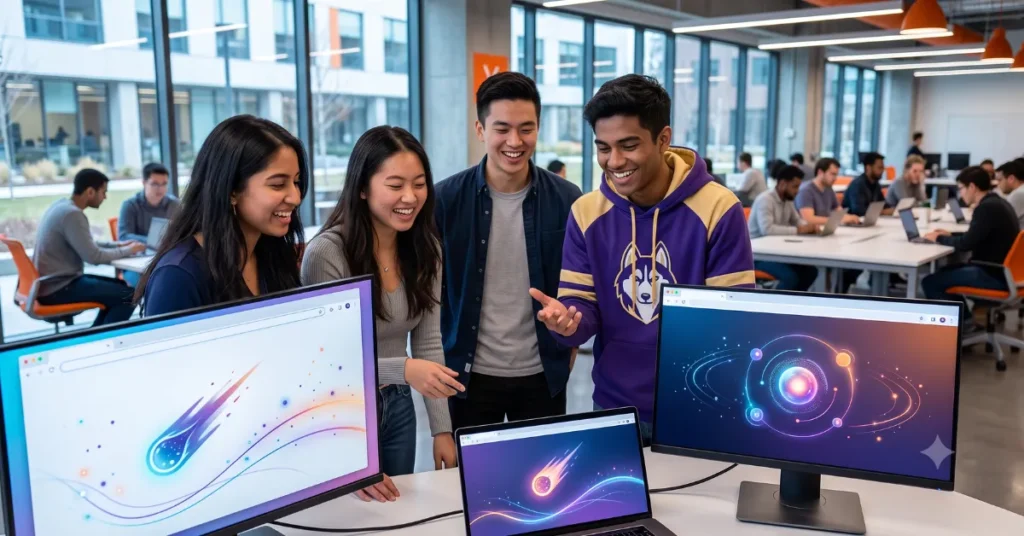
Two University of Washington computer science students have put their studies on hold to pursue an ambitious startup that aims to redefine web browsing with artificial intelligence. Their new company, Meteor, has officially launched through Y Combinator’s Summer 2025 accelerator program with a bold vision of turning the browser into an intelligent personal assistant.
Co-founders Pranav Madhukar and Farhan Khan believe today’s web browsers are outdated for the AI era. Instead of simply displaying websites, they envision a browser that can understand user requests, complete tasks independently, and proactively assist with everyday work.
“We’re on a mission to kill Chrome,” Madhukar said, jokingly adding that acquiring Google’s browser for $34.5 billion would also work—a reference to AI startup Perplexity’s recent offer to buy Chrome.
An AI Browser That Works for You
Meteor is built around agentic AI, allowing users to delegate tasks using natural language prompts instead of manually clicking through multiple websites.
The browser’s AI agents can perform a wide variety of activities, including:
- Adding events to a calendar
- Applying for internships
- Purchasing groceries
- Booking flight tickets
- Completing other repetitive online tasks
The browser can even complete homework assignments, further highlighting the growing debate around how artificial intelligence is changing education and productivity.
Users interact with Meteor through a chat-style interface, while a distinctive purple cursor visually takes over the browser to perform requested actions.
The founders also plan to introduce proactive suggestions through built-in browser buttons, along with future support for voice commands.
According to Madhukar, the long-term goal is simple: transform the web browser into a true personal assistant.
Built by UW Students
Madhukar and Khan first met during orientation week at the University of Washington in Seattle.
The pair were preparing to begin their junior year before deciding to pause their studies and focus full-time on building Meteor.
Before launching the startup, Madhukar had already gained attention among UW students by creating several popular campus tools.
One project, uwgeoguessr, challenged users to identify locations around the university using campus photographs.
He also built a website that allowed students to identify professors assigned to upcoming classes. The service attracted around 2,500 active users before it was eventually taken offline by university administrators, according to Madhukar.
Meanwhile, Khan, who serves as Meteor’s Chief Technology Officer, previously developed an integrated development environment for hardware design that he says compiles code 60 times faster than the industry standard.
Rebuilding Chromium for AI
Meteor is based on Chromium, the open-source browser project that powers Google Chrome.
However, only a few weeks after joining Y Combinator, the founders decided to create their own version of Chromium by forking its roughly 30 million lines of source code and rebuilding much of the browser from scratch.
The move allows Meteor to integrate AI much more deeply into the browsing experience instead of layering it on top of an existing browser.
Inspired by the AI Browser Race
Meteor joins a growing number of startups racing to reinvent web browsing with generative AI.
Companies such as Perplexity, through its Comet Browser, are also developing AI-powered browsers designed to automate online tasks and improve productivity.
Madhukar believes the traditional browser will look dramatically different within the next few years as AI becomes the primary way people interact with the web.
The founders say Y Combinator has reinforced the importance of moving quickly while remaining committed to their long-term vision.
Focused on Building the Future
For now, the two entrepreneurs remain in California while participating in Y Combinator, whose Summer 2025 program runs through September.
Although their long-term location remains undecided, Madhukar said they currently have no plans to return to the University of Washington in the near future.
Instead, their focus is entirely on growing Meteor and building what they believe could become the next generation of AI-powered web browsers.
As competition intensifies among companies seeking to reshape internet browsing with artificial intelligence, Meteor hopes its assistant-first approach will offer users a faster, smarter, and more automated way to navigate the web.
Also read : EU Lawmaker Probing Pegasus Spyware Was Hacked, Researchers Say