




Glowforge to Close Seattle Factory, Lay Off Workers
3 min read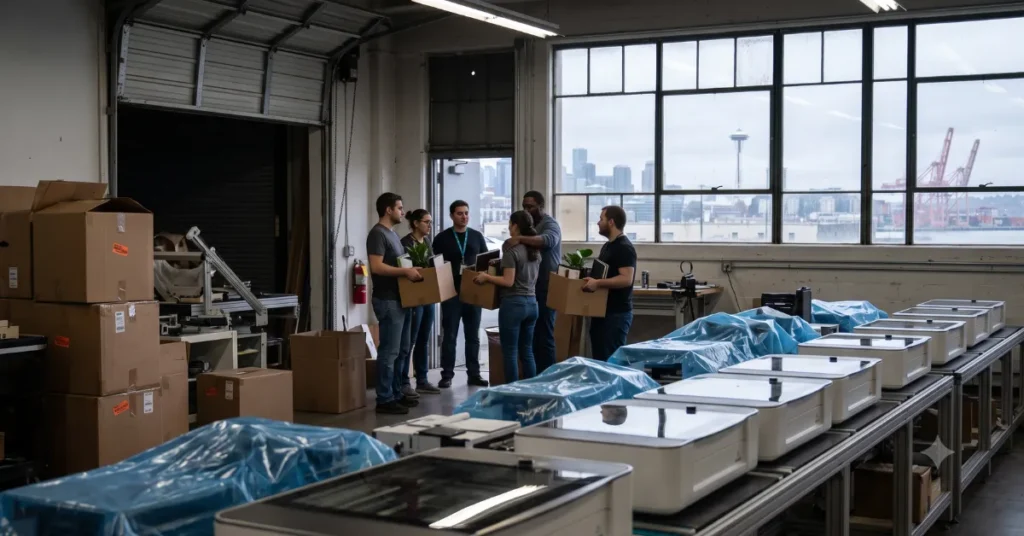
Seattle-based laser engraving startup Glowforge is shutting down its manufacturing facility in Seattle and laying off employees less than a year after bringing part of its production back to the United States.
The decision marks another major shift for the 10-year-old company, which had hoped domestic manufacturing would improve product quality, speed up innovation, and reduce uncertainty surrounding global supply chains.
Seattle Production to End Within Two Months
Glowforge co-founder and CEO Dan Shapiro told GeekWire that manufacturing at the company’s facility on Occidental Avenue South in Seattle’s SoDo neighborhood will end within the next two months.
The location also serves as Glowforge’s headquarters. While production is ending at the site, Shapiro said the company plans to establish a new office elsewhere in Seattle.
The CEO did not reveal how many employees are affected by the latest layoffs or provide an updated company headcount.
When GeekWire toured the factory in April, the facility employed 15 workers assembling the company’s premium laser engravers, including the $7,000 Glowforge Pro HD and the $5,000 Glowforge Plus HD.
At that time, Glowforge employed just over 90 full-time and contract workers.
Another Round of Workforce Reductions
The latest layoffs follow another workforce reduction in August, when Glowforge cut jobs across its sales and marketing departments, along with several senior leadership positions.
The company has experienced multiple rounds of restructuring over the past few years as it adapts to changing market conditions.
Glowforge also reduced staff during 2023 and 2024 after a planned funding round failed to close.
Domestic Manufacturing Improved Quality
Glowforge moved part of its manufacturing back to Seattle with the goal of gaining greater control over production while reducing exposure to uncertainties surrounding President Donald Trump’s tariff policies.
According to Shapiro, the experiment achieved impressive manufacturing results.
He said products built in Seattle delivered quality rates more than 50% better than those produced at the company’s previous manufacturing facility in Mexico.
The Seattle factory employed technicians with backgrounds in industries including aerospace, satellite manufacturing, and medical equipment production.
Expiring Lease and Tariffs Drove the Decision
Several factors contributed to the closure.
Shapiro said the lease on the SoDo facility is expiring, making it difficult to establish a permanent manufacturing operation.
He also pointed to redevelopment plans in Seattle’s industrial district following the Seattle City Council’s approval of additional housing projects in the area earlier this year.
Economic challenges also played a major role.
According to Shapiro, anticipated federal incentives designed to encourage domestic manufacturing never materialized.
Instead, the company faced higher costs from tariffs on imported components required to assemble its products in the United States.
AI Played a Key Role in the Factory
Glowforge’s Seattle factory also served as a testing ground for artificial intelligence in manufacturing.
The facility was equipped with cameras and microphones that enabled generative AI systems to analyze production processes, improve operational efficiency, and enhance workplace safety.
Shapiro previously said operating its own U.S. manufacturing facility gave the company greater flexibility to rapidly experiment with AI-driven production improvements than relying on third-party manufacturing partners.
Production Will Continue Elsewhere
Glowforge has not disclosed where manufacturing of its premium laser engravers will move after Seattle production ends.
The company’s lower-priced Aura and Spark machines will continue to be manufactured in Mexico.
Employees affected by the latest layoffs will receive severance packages, continued health insurance coverage, and outplacement assistance, according to the company.
A Well-Funded Startup Faces New Challenges
Founded in 2015, Glowforge has raised approximately $183 million in funding and currently ranks No. 125 on the GeekWire 200 startup index.
The company was launched by Dan Shapiro, Mark Gosselin, and Tony Wright, although Wright departed the business in 2017.
Before founding Glowforge, Shapiro sold startup Sparkbuy to Google and created Robot Turtles, a coding board game that became one of Kickstarter’s most successful crowdfunding campaigns.
While Glowforge says its move back to U.S. manufacturing significantly improved product quality and enabled AI-powered production innovation, rising operating costs, tariff pressures, and changing economic conditions ultimately led the company to end its Seattle manufacturing experiment.
Also read : EU Lawmaker Probing Pegasus Spyware Was Hacked, Researchers Say