


AI-Powered Cars Are Becoming Pothole Hunters for Cities
3 min read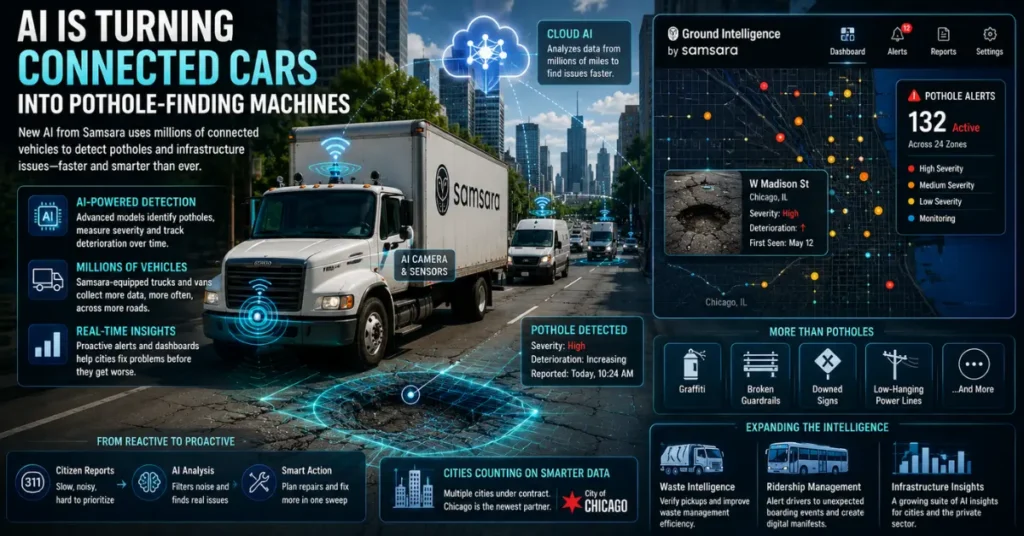
Potholes have frustrated drivers, cyclists, and city officials for decades, but artificial intelligence may finally be turning connected vehicles into a powerful tool for fixing the problem faster.
New technology from Samsara aims to transform millions of sensor-equipped commercial vehicles into mobile infrastructure monitors capable of detecting potholes, damaged roads, and other city hazards in real time.
The announcement comes shortly after Waymo and Waze revealed a pilot program that shares pothole information with local governments. But Samsara believes it can go much further thanks to the massive number of trucks and vans already using its technology.
The San Francisco-based company has spent years supplying businesses with dashboard cameras and vehicle monitoring systems used for driver safety, theft prevention, and accident investigations. Now, it has trained its own AI models using data collected from millions of connected vehicles.
The result is a new platform called “Ground Intelligence,” which can identify different types of potholes and even estimate how quickly road damage is worsening over time.
Unlike robotaxi fleets, which are still relatively small, Samsara says its commercial vehicle network gives it a major advantage. While Waymo currently operates roughly 3,000 autonomous vehicles, Samsara-equipped trucks are already driving across cities every day, repeatedly traveling the same roads and generating constant streams of updated data.
That repeat coverage is critical because it allows the AI system to monitor how potholes evolve rather than simply detecting them once.
Samsara says multiple cities have already signed contracts for the service, with Chicago joining as one of the newest customers.
The company believes the technology could dramatically improve how cities manage infrastructure problems. Traditionally, local governments often rely on public complaints through 311 systems or dispatch workers to inspect roads manually — a slow and reactive process.
Ground Intelligence changes that by automatically mapping developing potholes and other infrastructure issues through a centralized dashboard.
City workers can also review anonymized camera footage from vehicles to verify reports involving damaged signs, blocked drains, or other maintenance concerns.
According to Johan Land, Samsara’s senior vice president of product, the goal is to make road maintenance proactive instead of reactive.
Rather than fixing potholes one at a time after residents complain, cities could identify clusters of damage and repair entire areas in a single operation.
But potholes are only the beginning.
Samsara says the AI system could eventually detect graffiti, broken guardrails, low-hanging power lines, and many other municipal problems. The company believes nearly any visible infrastructure issue could potentially be monitored using its growing vehicle camera network.
Alongside Ground Intelligence, Samsara also introduced several other AI-powered tools this week.
One new service, called Waste Intelligence, helps sanitation companies verify whether trash and recycling pickups were completed successfully. Another system focuses on “ridership management,” allowing school buses and transit operators to monitor passenger activity and unexpected boarding events more effectively.
The broader trend reflects how modern vehicles are evolving into rolling sensor platforms packed with cameras, GPS systems, and AI-powered analytics.
As cities increasingly look for smarter ways to maintain aging infrastructure, connected vehicles may soon become one of the most important tools for spotting problems long before humans do.
Also read : Last Chance: 50% Off Second Pass for TechCrunch Disrupt 2026