




Safeworld Raises $12M to Make AI-Powered Robots Safer
4 min read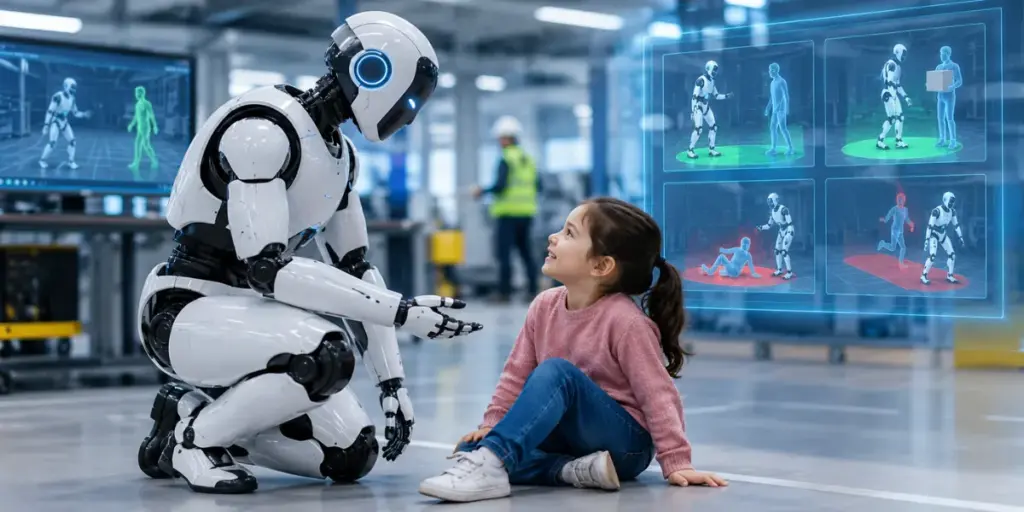
As generative AI becomes a bigger part of robotics, companies building humanoid and industrial robots face a difficult question: How can they prove that AI-powered machines will behave safely around people?
Traditional robotic systems often rely on predictable algorithms. Generative AI is different. Because AI models can produce different responses depending on the situation, predicting exactly how a robot will behave is much harder.
Safeworld, a new startup founded by robotics and AI experts, wants to tackle that problem.
The company was founded by Dr. Ding Zhao, director of the Safe AI Lab at Carnegie Mellon University, alongside startup executive Kyle Wong and machine learning engineer Simo Rachidi. Zhao has spent much of his career researching how to make AI systems safer.
Safeworld is now coming out of stealth with more than $12 million in seed funding. The round was led by Shine Capital and a16z Speedrun, with additional backing from Box Group, the Carnegie Mellon University Endowment, Innovation Endeavors and SV Angel.
The company is focused on two major challenges: evaluating the risks of probabilistic AI systems and building trust in robots before they are widely deployed.
“The safety challenge that we’re talking about is a combination of” advanced generative AI evaluations and trust, Zhao said, arguing that both are necessary before robots can safely enter the real world.
Testing robots before they meet people
Safeworld’s approach is based on simulation.
The startup creates virtual environments containing realistic human models and then tests robotic control systems against thousands of different situations. The idea is similar to how autonomous vehicle companies test systems against unexpected events on the road.
But robotics can be even more complicated because robots often operate in unstructured environments. A factory, warehouse or construction site can have its own unique layout and safety requirements.
For example, a robot working around a blind corner may need to slow down or stop at a specific distance to avoid hitting a person. The situation becomes even more complicated if that person is carrying boxes or suddenly changes direction.
Safeworld can recreate these environments digitally using simulation platforms such as Genesis or MuJoCo. The company’s system can then run the robot’s actual software through thousands of simulated scenarios.
Human behavior is one of the biggest challenges.
People can walk, run, crouch, kneel, trip or fall. Testing all of these situations in the physical world would be expensive and difficult. Simulation allows developers to test unusual scenarios repeatedly without putting real people at risk.
Why independent testing could matter
Robot companies already use simulation internally, but Safeworld believes there is a strong case for an independent company to evaluate robotic safety.
A third-party safety platform could also help companies establish common safety standards and share lessons about difficult edge cases without requiring every robotics company to solve the same problems independently.
a16z Speedrun partner Jonathan Lai said the timing is important because the industry is still developing its safety standards.
“The time to build an industry safety standard is now while robots are being designed and deployed,” Lai told TechCrunch.
He warned that waiting until robots are already operating inside homes and interacting with children could mean dealing with serious safety incidents too late.
Gritt Robotics is already testing the platform
Safeworld is working with Gritt Robotics, a company developing AI systems for robots that help workers install photovoltaic panels at large-scale solar farms.
Gritt Robotics CTO Vishal Dugar said proving robotic safety mathematically is difficult, particularly when robots work directly alongside humans. Instead, the company needs to test the systems empirically across many possible situations.
A human worker could be standing, kneeling, crouching, running or falling. People also vary widely in height, size, clothing, appearance and other physical characteristics.
For a robotic arm operating near workers, the system needs to account for as many of these possibilities as possible.
A growing challenge for AI robotics
Safeworld is still in the early stages of developing its business model. The company is considering whether its product will primarily be a software platform that customers use themselves or a more services-focused offering.
But the founders believe the need for robotic safety testing will grow rapidly as generative AI becomes more deeply integrated into robots.
The biggest concern, Zhao argues, isn’t necessarily a robot performing badly during a controlled demonstration. The real challenge comes when thousands of robots are deployed in the real world and used by people who may have little or no previous experience operating robots.
Safeworld believes that could create a major market for independent safety testing—and potentially make robotic safety a required part of deploying AI-powered machines at scale.
Also read : Blackstone’s Jas Khaira to Discuss Building AI Giants at Disrupt 2026