





Top AI Startups Shine at Google Cloud Next 2026
3 min read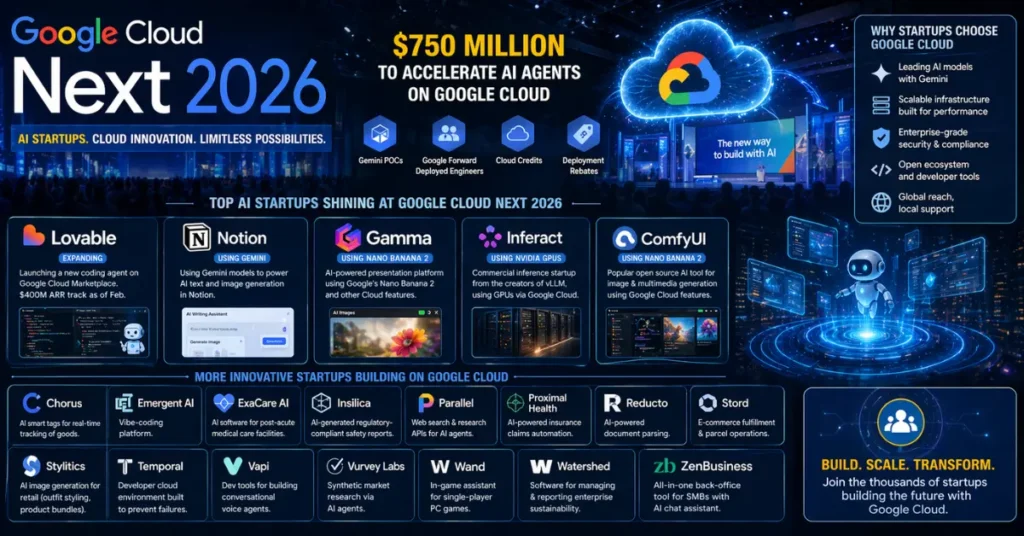
Google made one thing very clear at this year’s Google Cloud Next 2026 in Las Vegas: it wants startups—especially AI startups—building on its cloud.
To back that vision, the company unveiled a massive $750 million funding pool aimed at helping partners sell AI agents to enterprise customers. This budget isn’t just for big consulting firms—it’s also open to fast-growing startups looking to scale. The funds can be used for Gemini proof-of-concept projects, cloud credits, deployment rebates, and even access to Google engineers.
Big Names Betting on Google Cloud
Several high-profile startups are already deepening their relationship with Google Cloud—and their use of AI tools like Gemini.
Notion, valued at around $11 billion, is using Gemini models to power its AI-driven writing and image generation features. Meanwhile, Gamma—often described as a next-gen alternative to PowerPoint—is tapping into Google’s advanced image model “Nano Banana 2” to enhance its platform.
Another standout is Lovable, a rapidly growing “vibe-coding” startup that is expanding its footprint by launching a new coding agent through Google’s enterprise marketplace. The company was reportedly on track for $400 million in annual recurring revenue earlier this year.
On the infrastructure side, Inferact is leveraging Nvidia GPUs via Google Cloud, along with the broader AI stack, to support high-performance workloads.
Open Source and Creative AI Tools
Google also spotlighted tools that are popular among developers and creators. ComfyUI, widely used for building AI-generated visuals, is integrating Google Cloud features and offering access to its latest models.
These integrations highlight Google’s strategy: attract both enterprise customers and the developers building the tools they rely on.
A Broader Startup Ecosystem
Beyond the headline names, Google showcased a diverse mix of startups across industries:
- Chorus is building AI-powered smart tags to track goods in real time.
- Emergent AI focuses on vibe-coding platforms.
- ExaCare AI is improving post-acute healthcare with automation tools.
- Insilica generates compliant chemical safety reports using AI.
- Parallel develops research and search APIs for AI agents.
- Proximal Health automates insurance claims processing.
- Reducto specializes in AI-powered document parsing.
- Stord manages e-commerce fulfillment and logistics.
- Stylitics creates AI-generated retail visuals like outfit styling.
- Temporal builds developer tools to prevent system failures.
- Vapi enables developers to create conversational voice agents.
- Vurvey Labs uses AI agents for synthetic market research.
- Wand offers in-game AI assistants for PC gaming.
- Watershed helps companies manage sustainability reporting.
- ZenBusiness provides AI-powered back-office tools for small businesses.
Google’s Bigger Play
The message from Google is straightforward: AI is the future of cloud computing, and startups are key to that future.
By offering funding, infrastructure, and cutting-edge AI tools, Google is positioning itself as the go-to platform for the next wave of innovation. At the same time, it’s creating a strong ecosystem where startups can grow—and where enterprises can easily adopt AI solutions built on its cloud.
With competition heating up in the AI space, this startup-first strategy could play a major role in shaping how businesses adopt AI in the coming years.
Also read : Ex-Pinterest Team Reinvents Email With ‘Extra’