




Pillar Secures $20M to Bring AI Risk Tools to Commodities
2 min read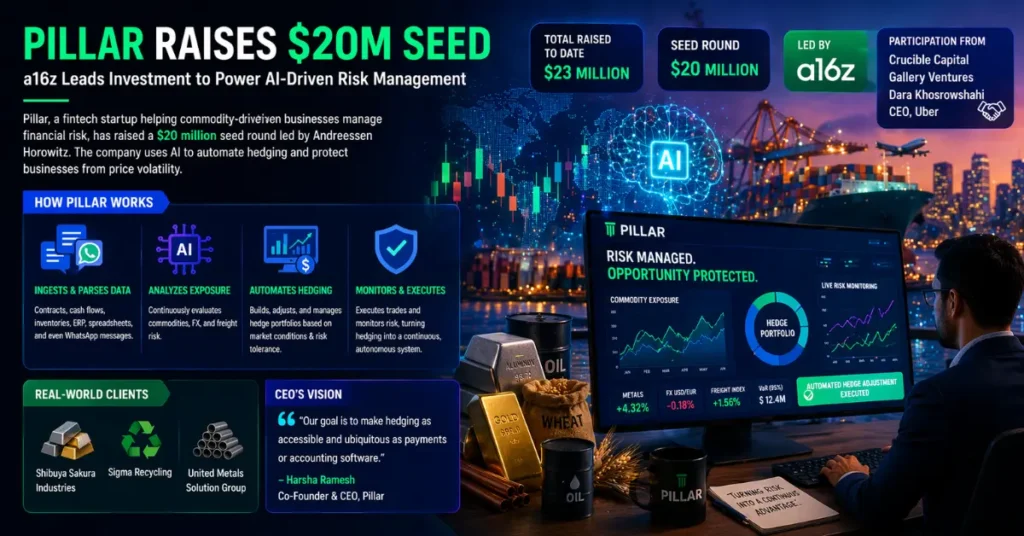
A fast-growing fintech startup is looking to reshape how businesses manage financial risk. Pillar has raised $20 million in a seed funding round led by Andreessen Horowitz, marking a strong vote of confidence in its AI-driven approach.
The round also drew participation from Crucible Capital, Gallery Ventures, and Dara Khosrowshahi. With this latest raise, Pillar has now secured a total of $23 million since its founding in 2023.
Bringing Wall Street Tools to Everyday Businesses
Pillar is focused on helping companies in commodity-heavy industries—such as metals, food, and aviation—better manage financial risks. These businesses often deal with fluctuating prices in raw materials, foreign exchange, and freight, making risk management critical.
At the heart of Pillar’s offering is automated hedging. In simple terms, hedging allows companies to offset potential losses by placing strategic trades. While large financial institutions have long used advanced systems for this, smaller businesses have often been left behind.
That’s exactly the gap Pillar wants to close.
How the Platform Works
Led by CEO Harsha Ramesh and CTO Chinmay Deshpande, the company uses artificial intelligence to analyze a wide range of business data. This includes contracts, cash flows, inventory data, ERP systems, spreadsheets—and even messages from platforms like WhatsApp.
By processing this information, the system continuously tracks exposure across commodities, currencies, and logistics costs. It then builds and manages a hedge portfolio tailored to each client.
The platform doesn’t stop there. It also automatically adjusts positions based on changing market conditions, volatility, and the company’s risk tolerance. According to Ramesh, this transforms hedging from a periodic task into a “continuous, autonomous system.”
Real-World Clients and Use Cases
Pillar is already working with companies such as Shibuya Sakura Industries, Sigma Recycling, and United Metals Solution Group—all of which operate in sectors where price swings can significantly impact profits.
Leveling the Playing Field
Ramesh brings firsthand experience to the problem. Before founding Pillar, he worked as a macro trader managing complex derivatives and helping large corporations hedge risks. He noticed a major imbalance: while big institutions had access to advanced tools and expertise, smaller producers and traders often had none.
Pillar aims to change that by making sophisticated risk management as easy to use as everyday business software.
Humans Still Play a Role
Despite its heavy use of AI, Pillar hasn’t removed humans from the process entirely. People still oversee approvals, handle complex transactions, and guide strategic decisions—especially for large or sensitive trades.
A Growing Competitive Space
Pillar enters a market that includes traditional bank trading desks as well as specialized platforms like Topaz and RadarRadar.
As volatility continues to shake global commodity markets, demand for smarter, more accessible risk tools is rising. With fresh funding and a clear mission, Pillar is positioning itself to meet that need—and potentially redefine how businesses handle financial risk.
Also read : Claude Steals the Spotlight at HumanX AI Event