





South Korea’s LetinAR Wants to Power the AI Glasses Boom
3 min read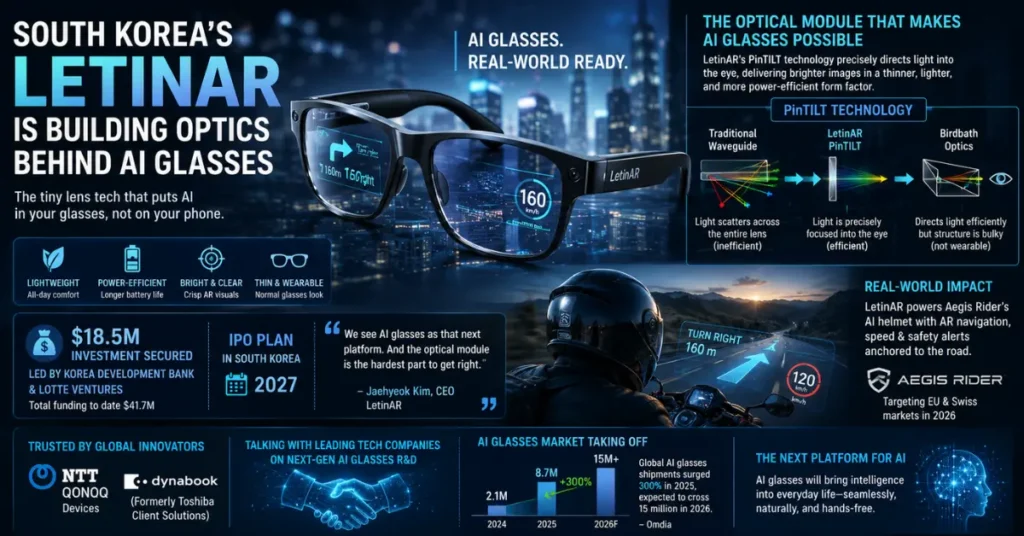
The global race to build AI-powered smart glasses is accelerating fast, and a South Korean startup called LetinAR is quietly becoming one of the key companies behind the technology.
While major tech giants compete to launch consumer-ready AI glasses, LetinAR is focusing on one of the hardest engineering problems in the industry: building optical lenses that are small, lightweight, and power-efficient enough for everyday wear.
The company recently secured $18.5 million in fresh funding from investors including Korea Development Bank and Lotte Ventures ahead of a planned South Korean IPO targeted for 2027.
Interest in AI glasses has exploded over the last few years. Meta has already been selling AI-enabled Ray-Ban smart glasses since 2023, while Google continues developing Android XR. Apple is also widely expected to enter the category, and reports suggest Samsung Electronics could unveil its first AI smart glasses later this year in partnership with Gentle Monster.
Chinese tech companies including Huawei, Alibaba, and Xiaomi are also aggressively expanding into the market.
Industry momentum is growing rapidly. According to Omdia, global AI glasses shipments jumped to 8.7 million units in 2025, representing growth of more than 300% year-over-year. Analysts now expect shipments to surpass 15 million units this year.
Unlike the companies building the glasses themselves, LetinAR develops the optical module that projects digital images into the user’s field of vision. According to co-founders Jaehyeok Kim and Jeonghun Ha, making these modules thin, bright, lightweight, and energy-efficient is one of the biggest technical hurdles in the entire smart glasses industry.
The startup’s core technology is called PinTILT, a proprietary optical system designed to direct light more efficiently into the wearer’s eye. Traditional waveguide systems often scatter large amounts of light, reducing brightness and draining battery life faster. Other alternatives, such as birdbath optics, can deliver clearer visuals but are too bulky for normal-looking glasses.
LetinAR says its PinTILT approach avoids both problems by carefully focusing only the light that actually reaches the user’s eye. The result is a thinner and lighter lens that can still produce bright images while using less power.
That combination could become increasingly important as AI glasses move closer to mainstream consumer adoption.
The company already has real-world customers. LetinAR currently works with Japan’s NTT QONOQ Devices and Dynabook, formerly known as Toshiba Client Solutions.
One of its most advanced partnerships involves Aegis Rider, a deeptech startup spun out of ETH Zurich’s Computer Vision Lab. Aegis Rider is developing an AI-powered augmented reality motorcycle helmet capable of displaying navigation, speed, and safety information directly onto the road ahead from the rider’s perspective.
LetinAR’s optical module powers the system inside the helmet, which is expected to target European and Swiss markets starting in 2026.
The company said the latest funding round brings its total capital raised to $41.7 million and will help expand production as the AI glasses industry moves from early experimentation into large-scale manufacturing.
Executives at LetinAR believe AI-powered wearable devices could become the next major computing platform, bringing artificial intelligence into daily life beyond smartphones and traditional screens.
Also read: Origin Lab Raises $8M to Turn Video Games Into AI Training Data