





Trust Takes Center Stage in Musk vs. OpenAI Trial
3 min read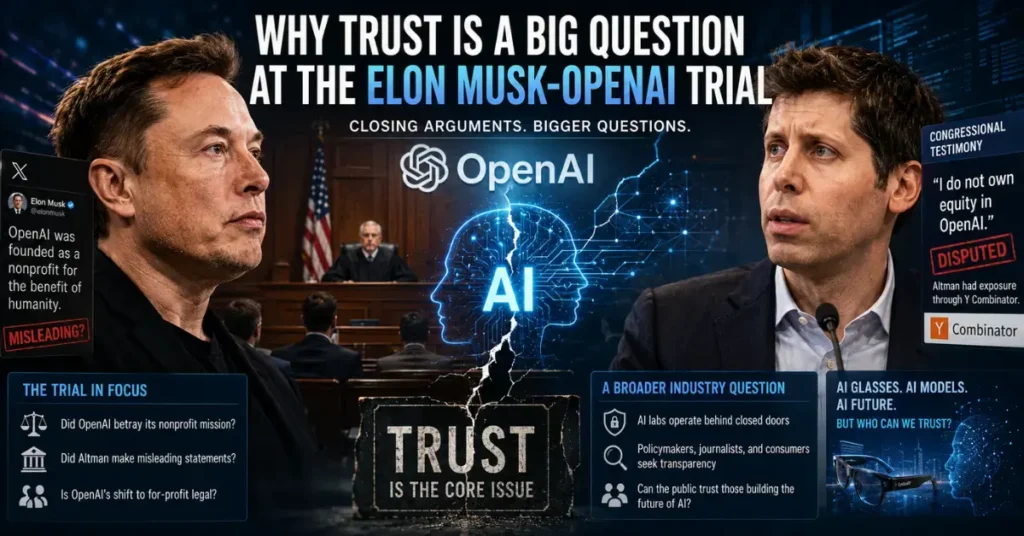
The legal battle between Elon Musk and OpenAI is nearing its conclusion, but one issue has emerged as the central theme of the trial: trust.
As closing arguments wrapped up this week, jurors were left to decide whether OpenAI crossed ethical or legal lines as the company evolved from its nonprofit roots into a more commercially driven AI business. But beyond corporate structure and financial motives, much of the courtroom attention focused on whether OpenAI CEO Sam Altman can be trusted.
During the final days of testimony, Musk’s attorney Steve Molo repeatedly challenged Altman over past public statements, including comments made during congressional testimony.
One major point of scrutiny involved Altman previously saying he did not hold equity in OpenAI.
Critics argued that statement was misleading because Altman reportedly had indirect exposure through Y Combinator, the startup accelerator he formerly led. Altman defended himself by saying he assumed people understood the difference between directly owning shares and being a passive investor in a venture capital fund.
That explanation became one of the more debated moments of the trial.
The issue has sparked wider conversations across the tech industry about transparency and accountability among major AI companies. On a recent episode of TechCrunch’s Equity podcast, journalists discussed how the case reflects a broader concern surrounding trust in AI leadership.
TechCrunch editor Kirsten Korosec argued that the debate extends far beyond Altman alone. She noted that consumers, policymakers, and journalists increasingly struggle to understand what is happening inside private AI companies because much of their operations remain hidden from public view.
According to Korosec, the trial highlighted a growing industry-wide question: should the public trust AI labs that are rapidly shaping the future of technology while operating behind closed doors?
She also pointed out that trust concerns are not limited to Altman. Musk himself has faced criticism over misleading public statements in the past, including controversial posts on social media platform X.
The contrast between how Musk and Altman handled scrutiny in court also drew attention. Observers noted that Musk reportedly appeared more combative while responding to questions, whereas Altman presented himself as more reflective and approachable, even acknowledging that he has sometimes been conflict-averse and too eager to tell people what they want to hear.
Still, some commentators remained unconvinced.
TechCrunch reporter Sean O’Kane openly stated during the discussion that he does not trust Altman, though he added that he generally approaches most tech leaders with skepticism.
The trial has also raised questions about whether both sides may come away politically or reputationally damaged regardless of the legal outcome. What began as a dispute tied to OpenAI’s shift toward commercialization has increasingly become a public examination of leadership credibility inside the fast-growing AI industry.
For many observers, the case now represents something bigger than a disagreement between two high-profile tech figures. It reflects growing public concern over how much power AI companies hold, how transparent they are with the public, and whether the people leading them deserve the trust they ask for.
Also read : Origin Lab Raises $8M to Turn Video Games Into AI Training Data