





Amazon Hit With Lawsuit Over Ring Facial Recognition Tool
3 min read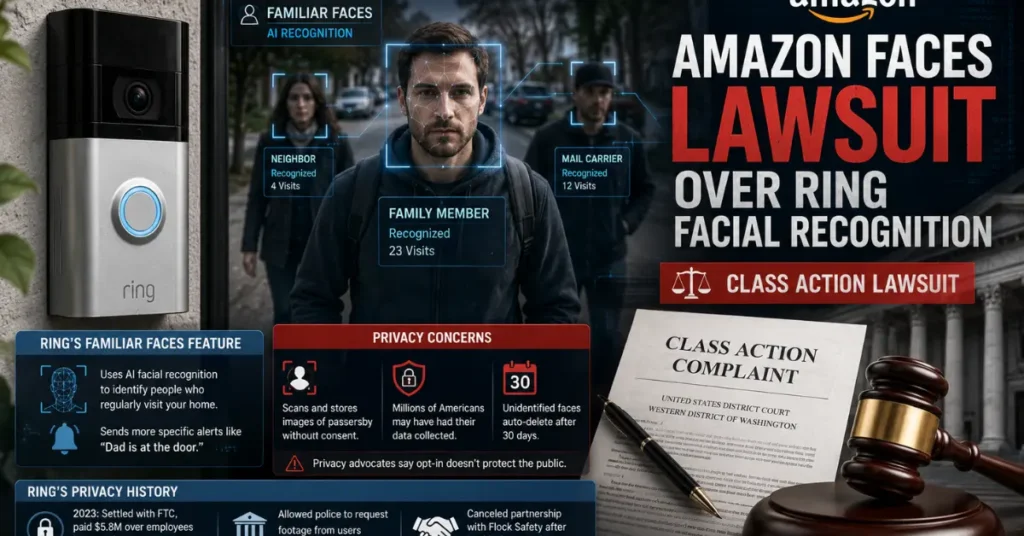
Amazon is facing a new legal challenge over privacy concerns tied to its Ring smart doorbell cameras. A proposed class action lawsuit filed in Seattle alleges that Ring’s facial-recognition technology collects and stores images of people without their knowledge or consent.
The lawsuit was brought by Virginia resident Charles Sigwalt, who claims that Ring’s Familiar Faces feature violates privacy rights by scanning and retaining facial data from individuals who may simply walk past a home equipped with a Ring camera.
The legal dispute centers on Ring’s Familiar Faces tool, which Amazon introduced last year and officially launched in December despite criticism from privacy advocates and lawmakers.
The feature uses artificial intelligence-powered facial recognition to identify people who frequently visit a home. When enabled, Ring can recognize recurring visitors such as family members, neighbors, or delivery workers and send more personalized notifications. Instead of receiving a generic alert stating that a person is at the door, users may receive messages identifying the individual by name.
While homeowners must actively opt into the feature, critics argue that people being scanned by the cameras never agreed to have their facial information analyzed or stored.
According to the lawsuit, millions of Americans may have unknowingly had their facial recognition data collected while passing by Ring-equipped homes.
Privacy Concerns Surround Familiar Faces
Consumer privacy organizations raised concerns about the technology long before its launch. Groups such as the Electronic Frontier Foundation (EFF) warned that facial-recognition systems could create significant privacy risks, particularly when individuals are scanned without their consent.
Senator Ed Markey also expressed concerns about the feature before its release.
Despite the criticism, Amazon proceeded with the rollout, maintaining that the system was designed with privacy protections in place. At launch, the company stated that facial data collected through Familiar Faces is encrypted and never shared with third parties. Amazon also said unidentified facial data is automatically deleted after 30 days.
The company has not publicly commented on the latest lawsuit.
Ring’s Privacy History Faces Renewed Scrutiny
The lawsuit arrives as Ring continues to face questions about its handling of user privacy.
In 2023, Amazon reached a settlement with the Federal Trade Commission over allegations that Ring employees and contractors improperly accessed private customer videos. The settlement included a $5.8 million payment.
According to the FTC complaint, employees had broad access to customer footage, even when access was not necessary for their job responsibilities.
Ring has also faced criticism for its past relationships with law enforcement agencies. The company previously allowed police departments to request video footage from Ring users without obtaining a warrant, sparking concerns among privacy advocates.
Previous AI Features Also Drew Backlash
Privacy concerns have emerged around other Ring initiatives as well.
Earlier this year, the company promoted Search Party, an AI-powered tool designed to help locate lost pets using footage captured by Ring cameras. The feature received criticism from some privacy groups who argued it expanded surveillance capabilities.
Shortly afterward, Ring abandoned plans to partner with video surveillance company Flock Safety. The proposed collaboration drew attention because Flock Safety has reportedly shared footage with federal agencies, including Immigration and Customs Enforcement (ICE).
Ring founder Jamie Siminoff later suggested that the partnership would have created excessive operational demands, contributing to the decision to end the arrangement.
As the lawsuit moves forward, it could become an important test of how courts view facial-recognition technology, consent requirements, and privacy protections in an era of increasingly AI-powered consumer devices.
Also read : Europe Bets on AI Governance Over Silicon Valley Speed