




Former E-Scooter Founder Raises $5M for Space Data Centers
3 min read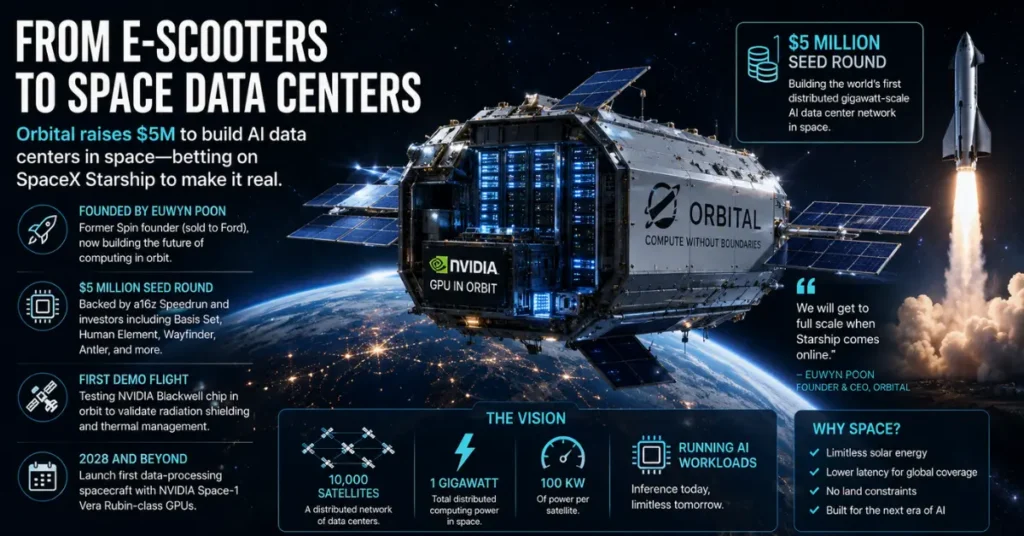
A startup aiming to bring AI computing into orbit has secured $5 million in seed funding, proving just how much investor enthusiasm for the space industry has grown in recent years. The company, called Orbital, was launched by former Spin founder Euwyn Poon and is betting that future advances in space transportation will make large-scale computing in space a reality.
Orbital emerged in May from Andreessen Horowitz’s Speedrun startup accelerator program. Alongside a16z, the funding round attracted backing from several investors, including Basis Set, Human Element, Wayfinder, Antler, Anti Fund, Ascent, Rubik, Zero Knowledge Ventures, LYVC, Feld Ventures, New Legacy, FNDR, UpHonest, and Asterisk.
From E-Scooters to Space Infrastructure
Poon is best known for founding the e-scooter company Spin in 2017. Just one year later, Ford acquired the company, bringing Poon into the automotive giant’s leadership ranks.
When he decided to launch another startup, Poon explored several business ideas before settling on a concept that sits at the intersection of artificial intelligence and aerospace: space-based data centers.
The idea is built around a growing challenge in the AI industry. Demand for computing power continues to surge, while building new data centers on Earth often faces high costs, energy constraints, and lengthy approval processes.
Space, in theory, offers nearly unlimited solar energy and fewer environmental restrictions. The major obstacle remains the cost of getting hardware into orbit.
Betting on SpaceX and Starship
Like several other startups pursuing similar ambitions, Orbital is counting on SpaceX’s Starship rocket becoming commercially available.
According to Poon, current launch costs using Falcon 9 rockets make large-scale space data centers economically impractical. However, he believes Starship could dramatically reduce launch expenses and unlock an entirely new market.
“We will get to full scale when Starship comes online,” Poon said.
Until then, the company is focusing on smaller milestones.
Testing AI Hardware in Orbit
Orbital currently employs around a dozen people in Los Angeles, including former employees from Amazon’s low-Earth orbit projects, SpaceX, and Northrop Grumman.
The startup plans to conduct a demonstration mission by placing an Nvidia Blackwell chip aboard a partner satellite. The test will evaluate Orbital’s radiation shielding and thermal management technologies, both critical for operating advanced AI hardware in space.
Looking further ahead, Orbital hopes to launch its first dedicated data-processing spacecraft in 2028. The spacecraft is expected to use Nvidia’s Space-1 Vera Rubin-class GPUs.
Initially, the company plans to perform smaller inference workloads in orbit, generating revenue with each satellite launch while building toward a larger network.
A Massive Long-Term Vision
Orbital’s ultimate goal is ambitious: deploying 10,000 satellites capable of delivering a combined gigawatt of computing power.
Each satellite would provide roughly 100 kilowatts of power. For comparison, Elon Musk has said future SpaceX AI satellites could generate up to 150 kilowatts, while rival startup Starcloud is targeting spacecraft capable of producing around 200 kilowatts.
Competition in the emerging space-data-center sector is already heating up. Starcloud has already placed a GPU in orbit and plans additional launches. Meanwhile, Cowboy Space Company has begun developing its own rockets, and Blue Origin has announced plans to use its New Glenn launch vehicle for future space-based data center projects.
Investors Embrace Bigger Bets
According to a16z partner Andrew Chen, investors today are far more willing to support long-term, capital-intensive projects than they were a decade ago.
Chen believes Poon’s experience scaling Spin to 250,000 scooters across 100 cities demonstrates the operational skills needed to tackle a complex aerospace venture.
While a project of this scale could eventually require more than $5 billion and take a decade or longer to fully realize, venture capital firms appear increasingly comfortable backing ambitious space infrastructure plays.
For Poon, the journey toward building data centers in orbit began unexpectedly after experimenting with an Nvidia A100 GPU hosted in a California data center. That experience convinced him that compute power would become one of the most valuable resources in the AI era.
Now, he plans to take that computing power beyond Earth—and into space.
Also read : Bending Spoons Files for U.S. IPO After Acquisition Spree