




US Raises Alarm Over ASML Chip Tool in China, Company Denies Claim
4 min read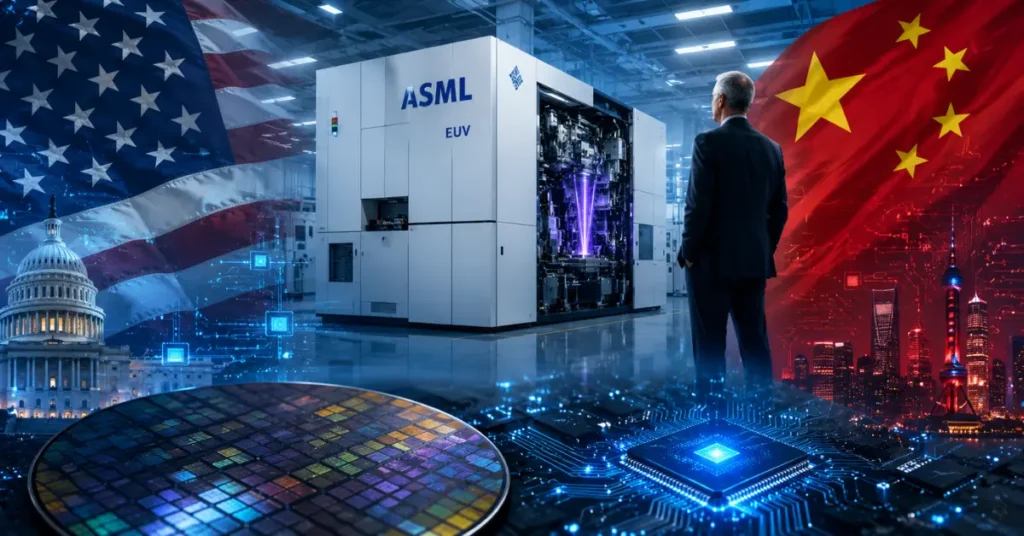
The United States and Dutch semiconductor equipment giant ASML appear to be at odds over a serious claim involving one of the world’s most advanced chipmaking machines. U.S. officials believe an ASML extreme ultraviolet (EUV) lithography system may have found its way into China, while the company firmly insists that no such machine has ever been delivered there.
According to Bloomberg, U.S. Commerce Secretary Howard Lutnick has privately expressed concerns during recent meetings with senior ASML executives that an EUV machine could be operating in China. If true, the discovery would represent a significant violation of export controls that have prevented ASML from selling EUV systems to Chinese customers since the first Trump administration.
The allegation is significant because EUV lithography machines are the only equipment in the world capable of producing the most advanced semiconductor chips. They play a critical role in manufacturing cutting-edge processors used in artificial intelligence, high-performance computing, and modern smartphones.
Despite the concerns raised by Washington, ASML strongly disputes the claim. The company says no EUV machine has ever been shipped to China and maintains that it has no knowledge of such a system existing there.
Bloomberg also reported that senior U.S. administration officials claim they possess evidence showing ASML shipped EUV-related components and transportation equipment to China. However, officials have reportedly declined to share that evidence publicly or provide it directly to ASML. The U.S. Commerce Department also did not answer Bloomberg’s questions regarding whether it possesses proof that a complete EUV machine is currently located inside China.
Why ASML Matters to the Global Chip Industry
Although ASML is not widely known outside the technology sector, it occupies one of the most important positions in the global semiconductor supply chain.
The Dutch company is the world’s only manufacturer of EUV lithography machines, making it indispensable to leading chipmakers. Every advanced processor produced by Taiwan Semiconductor Manufacturing Company (TSMC), including chips designed by Nvidia and Apple, relies on ASML’s technology.
Developing EUV technology required roughly two decades of research and billions of dollars in investment. To date, no competing company has successfully built a commercial alternative, giving ASML a unique monopoly in one of the world’s most critical technology markets.
That dominance has helped make ASML Europe’s most valuable publicly traded company, with its market capitalization hovering around $700 billion this week as demand for AI chips continues to surge.
CEO Rejects the Allegations
Several weeks before Bloomberg’s report was published, ASML CEO Christophe Fouquet addressed concerns about China during an interview.
Fouquet explained that ASML keeps detailed records of every machine it has ever shipped. According to him, each system is either actively operating with approved customers under company oversight or has been dismantled and returned to ASML.
He also described the company’s strict internal safeguards surrounding EUV technology. Employees with access to sensitive EUV knowledge, documentation, and training are separated from staff without authorization, and ASML’s China-based employees are intentionally excluded from those resources.
Fouquet argued that recreating an EUV machine without direct access would be nearly impossible. While much of the technology builds on decades of existing engineering, he noted that developing the specialized EUV light source alone required approximately 20 years of work. In his view, China cannot reverse-engineer a machine it has never possessed.
Business Risks Make Illegal Sales Unlikely
ASML continues to sell older-generation deep ultraviolet (DUV) lithography machines to China under existing export rules. These systems are less advanced than EUV equipment and have been commercially available for years.
Fouquet said those approved sales are carefully managed to maintain a technological gap while allowing legitimate business to continue. China is expected to account for around 20% of ASML’s revenue in 2026 through these authorized DUV sales.
Selling an EUV machine illegally would jeopardize not only those revenues but also ASML’s global reputation and export licenses. For that reason, Fouquet suggested such a move would make little commercial sense.
Politics Add Another Layer to the Debate
The allegations come as the U.S. government continues investing in technologies that could eventually challenge parts of ASML’s dominance.
Last year, the Commerce Department agreed to invest up to $150 million in xLight, a startup developing next-generation light-source technology related to EUV systems. While xLight’s CEO has previously described the company as a future partner rather than a competitor to ASML, Fouquet has expressed confidence that ASML does not require the startup’s technology to maintain its leadership.
Another startup, Substrate, backed by investor Peter Thiel, is pursuing technology designed to compete more directly with ASML’s lithography systems.
Meanwhile, lawmakers in Washington are considering even stricter export controls. A bipartisan bill moving through Congress would expand restrictions beyond EUV systems by effectively banning ASML from shipping DUV equipment to China. Those machines are expected to generate roughly one-fifth of the company’s 2026 revenue. Although the proposal cleared a key congressional committee in April, the Trump administration has not yet announced an official position.
For now, the central question remains unresolved. U.S. officials insist they have evidence supporting their concerns, while ASML continues to categorically deny that any EUV machine has ever reached China. Until the government releases its evidence, the dispute is likely to remain one of the semiconductor industry’s most closely watched stories.
Also read : How to Disable Gemini AI Pop-Ups in Google Docs