




Robotaxi Startup Aseon Labs Raises $10M to Cut Costly Empty Miles
3 min read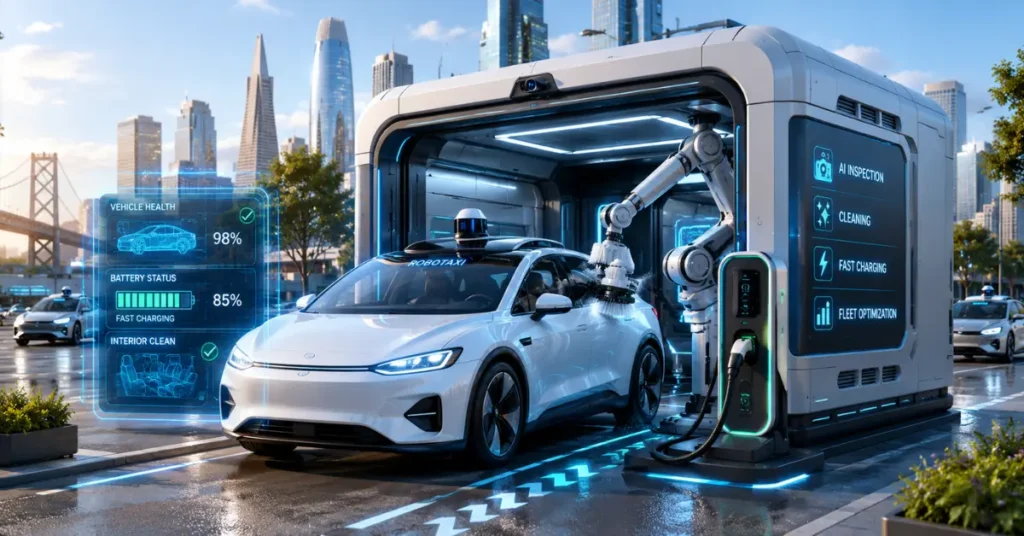
The race to make robotaxis profitable has inspired a new startup to rethink one of the industry’s biggest challenges: the time autonomous vehicles spend driving without passengers. California-based Aseon Labs believes it has found a practical solution, and investors are already backing the idea.
The Redwood City startup has secured $10 million in seed funding to develop a network of compact automated service pods designed specifically for robotaxis. The funding round was led by Crane Venture Partners, with participation from Y Combinator, Expa—the venture firm founded by Uber co-founder Garrett Camp—along with Robin Hood Ventures, Founders Capital, and several notable angel investors.
Among those supporting the company are former Google executive and serial entrepreneur Adrian Aoun, Mercury founder and CEO Immad Akhund, Zimride co-founder Rajat Suri, as well as operators and founding team members from Anthropic, Nuro, Turo, and Revolut.
Solving the Problem of Empty Robotaxi Trips
In cities like San Francisco, it’s common to see autonomous vehicles driving without passengers. These vehicles are often traveling to charging stations or maintenance depots, creating what the industry calls “deadhead miles”—trips made without generating revenue.
According to Aseon Labs, these unnecessary miles are one of the biggest obstacles preventing robotaxi companies from becoming profitable.
The company’s answer is a network of automated service pods that occupy roughly the space of a parking spot. These units can be placed across urban areas, allowing robotaxis to stop nearby for charging, inspections, interior cleaning, and even retrieving lost items instead of driving long distances to centralized facilities.
Funding Will Support Prototype Development
Aseon Labs is still in its early stages, but it already has ambitious plans. Co-founder and CEO George Kalligeros said the newly raised capital will help the company build five prototype pods, expand its robotics and engineering team from six employees to around twelve, and secure locations where the network can be deployed.
Kalligeros believes increasing vehicle usage is essential if autonomous ride-hailing services are to compete economically with traditional ride-hailing platforms.
He explained that robotaxis need to remain in operation throughout the day instead of spending valuable time traveling to distant depots for routine servicing.
Experience From Battery-Swapping Infrastructure
Although the founders are newcomers to the autonomous vehicle industry, they bring relevant experience in building hardware infrastructure.
George Kalligeros previously worked as a mechanical design engineer at Bentley Motors and Tesla before launching battery-swapping startup Pushme alongside co-founder and COO Dan Keene in 2016.
Pushme developed battery-swapping infrastructure for micromobility fleets across Europe before being acquired by Tier Mobility in January 2020.
Kalligeros said that experience taught the team how to rapidly deploy infrastructure throughout cities while keeping installations flexible and easy to relocate. Aseon Labs is now applying that same strategy to robotaxi operations.
Smaller, Movable Service Stations
After visiting several autonomous vehicle depots, the founders noticed that many are built outside city centers due to high real estate costs. Since most ride-hailing demand happens downtown, robotaxis often waste time and money traveling between passengers and remote maintenance facilities.
To solve this, Aseon Labs designed compact, independently powered pods that can be distributed throughout a city and moved if demand changes. Because the units are classified as temporary structures, they avoid lengthy permitting processes while giving operators greater flexibility.
Each pod includes cameras that inspect vehicles and robotic arms capable of cleaning interiors and collecting forgotten belongings. They can operate using propane generators or connect to existing power sources through partnerships with EV charging companies.
While the long-term goal is full automation, the first versions will initially include human staff.
AI Helps Decide When Humans Are Needed
Rather than attempting to solve every maintenance issue, Aseon Labs uses computer vision and AI powered by vision-language-action models commonly used in robotics.
The system identifies situations that require human intervention. For example, if the cameras detect melted chocolate on a vehicle’s seat, the robotic arm will avoid cleaning it because doing so could spread the stain. Instead, the robotaxi will simply be charged before being sent to a central depot where human workers can handle the problem.
Although Aseon Labs has not yet signed contracts with robotaxi operators, Kalligeros said industry interest has been strong. According to him, nearly every company the startup has spoken with is eager to test the technology, highlighting growing demand for solutions that can improve robotaxi efficiency and reduce operating costs.
Also read : Netris Raises $15M to Speed Up AI Data Center Launches