





Nvidia Faces New Pressure as AI Memory Demand Outpaces GPUs
3 min read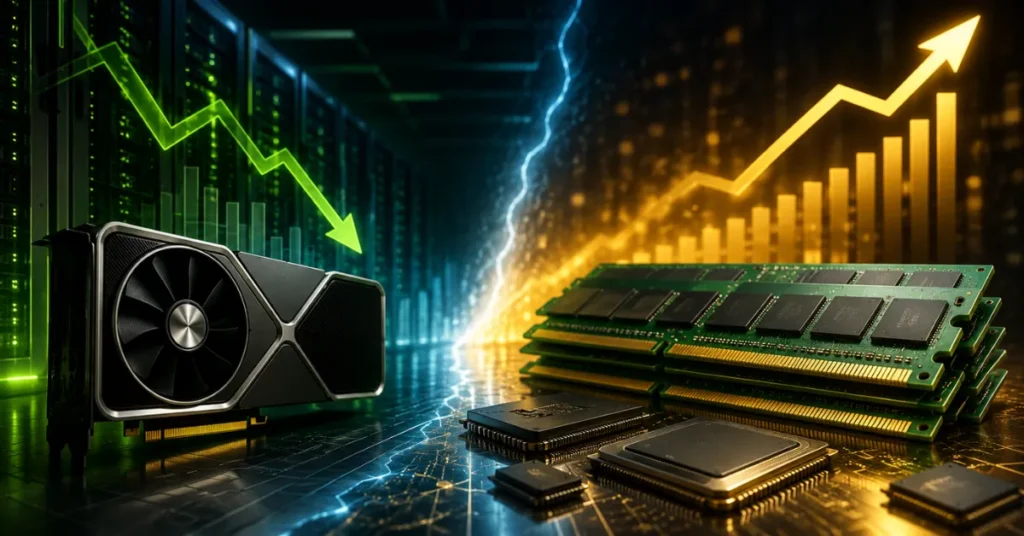
Nvidia has been the undisputed leader of the artificial intelligence hardware boom for years, but the company is now facing a different kind of challenge. While AI investment continues to surge, investors are shifting their attention toward memory chip makers instead of GPU manufacturers, highlighting how quickly the AI infrastructure landscape is evolving.
Despite strong revenue forecasts, Nvidia has experienced a difficult stretch in the stock market. According to Bloomberg, the company’s shares have fallen around 15% from their peak in May. That decline has made Nvidia appear less expensive relative to its expected earnings than the average company in the S&P 500, meaning investors are currently paying less for every dollar of Nvidia’s projected profit than they do for many other major U.S. businesses.
The broader AI industry, however, is far from slowing down.
Capital is still pouring into AI infrastructure, but much of that investment is now flowing toward memory manufacturers. One of the biggest winners has been Micron, one of the world’s leading producers of DRAM memory chips. Since May, the company’s market value has nearly tripled as demand for memory continues to surge.
The shift reflects a major change in what data centers need most. Last year, graphics processing units (GPUs) were in extremely short supply, creating fierce competition among companies building AI models. That shortage has now eased, but another challenge has emerged. Modern AI systems require enormous amounts of high-bandwidth memory (HBM) and DRAM to move data quickly between processors, making memory the latest bottleneck in AI infrastructure.
Nvidia’s rise has been built on years of technological innovation. Its CUDA software platform helped establish Nvidia GPUs as the standard hardware for AI development, while the company consistently pushed GPU performance forward at a pace few competitors could match. Many industry experts consider Nvidia’s processors among the most advanced computing devices ever created.
Memory manufacturers, on the other hand, have taken a much less dramatic path. Companies like Micron have steadily improved high-bandwidth memory technology over the past two decades. There has been no revolutionary breakthrough in recent months, yet demand has exploded as AI data centers require more memory than manufacturers can currently supply.
That supply-demand imbalance has had a dramatic impact on pricing. Spot prices for DRAM—the open-market price buyers pay outside long-term contracts—have increased sharply since 2023. While it may appear that a major technological advancement caused the jump, the reality is much simpler: the industry underestimated just how much memory would be needed to support today’s AI expansion.
Meanwhile, the economics of GPU computing are moving in the opposite direction. Data from compute marketplace Ornn shows that the spot price for renting an Nvidia H100 GPU peaked at roughly $3.20 per hour in May before steadily declining throughout the following months.
This trend mirrors Nvidia’s stock performance. As compute becomes more widely available, the cost of accessing powerful GPUs is falling, reducing some of the pricing power Nvidia previously enjoyed.
According to Ornn co-founder and CTO Wayne Nelms, increasing competition is playing a major role. Large technology companies including Google, Amazon, Microsoft, and even OpenAI have introduced custom AI processors to reduce their dependence on Nvidia hardware. While these chips may not outperform Nvidia’s latest GPUs, they provide enough computing power to increase overall supply and put downward pressure on compute prices.
Nelms believes the memory market tells a different story.
“More GPU and accelerator players are entering the market. Everyone wants to make their own silicon, but no one is making their own DRAM,” he said. He added that unless there is a significant breakthrough in high-bandwidth memory technology, a major change in supply and demand, or new competitors enter the memory market, current pricing trends are likely to continue.
Ironically, Nvidia’s current challenge is partly the result of its own success. By proving the enormous value of AI computing, the company helped create a highly competitive market where more businesses are developing their own AI chips. At the same time, memory suppliers—using technology that has evolved steadily rather than dramatically—are benefiting from soaring demand and limited supply.
As AI infrastructure continues to expand worldwide, Nvidia remains one of the industry’s most influential companies. However, the latest market trends suggest that the biggest gains may now be shifting toward the memory companies powering the next generation of AI data centers.
Also read : Paradigm Raises $1.2B to Back Crypto, AI and Robotics Startups