





Pentagon Expands AI Push With Nvidia, Microsoft, AWS Deals
2 min read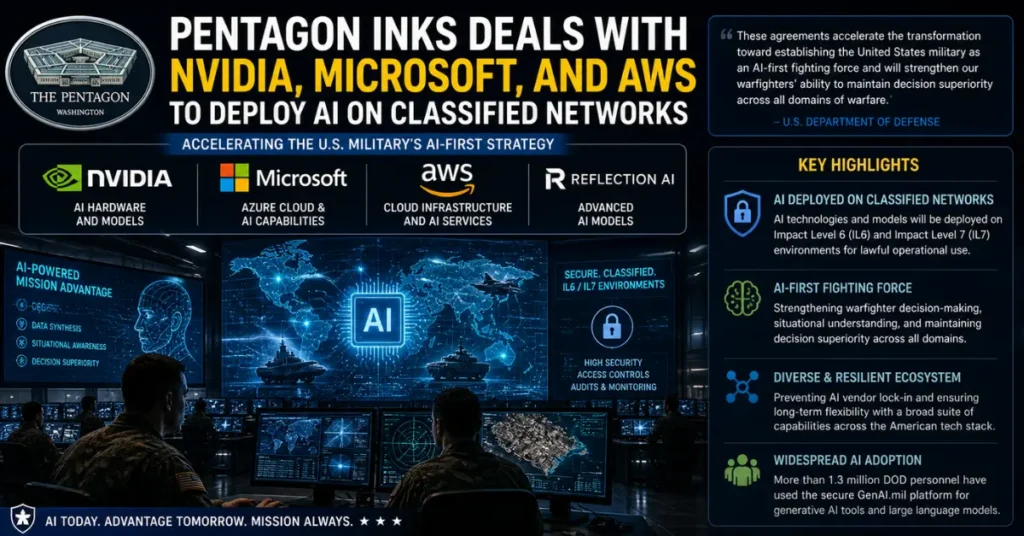
The U.S. Department of Defense is doubling down on artificial intelligence, announcing new agreements with major tech players to bring advanced AI tools into its most secure systems.
The Pentagon confirmed deals with Nvidia, Microsoft, Amazon Web Services, and Reflection AI. These partnerships will allow the military to deploy AI models and infrastructure directly on classified networks for what it described as “lawful operational use.”
Building an “AI-First” Military
According to the Pentagon, the move is part of a broader strategy to transform the U.S. military into an “AI-first fighting force.” The goal is to improve decision-making speed and maintain an edge across modern warfare domains.
By integrating AI into secure environments, officials say they can enhance data analysis, situational awareness, and operational planning—all critical in high-stakes scenarios.
Secured Deployment on Classified Networks
The new systems will operate within high-security environments known as Impact Level 6 (IL6) and Impact Level 7 (IL7). These are among the most tightly controlled networks in the defense ecosystem, used for handling highly sensitive national security data.
Deploying AI at these levels means strict safeguards, including physical security, access controls, and continuous monitoring.
Diversifying AI Partnerships
The announcement follows earlier deals with companies like Google, SpaceX, and OpenAI.
The Pentagon appears to be spreading its bets across multiple vendors, aiming to avoid reliance on a single provider. Officials say this approach helps ensure flexibility and resilience in rapidly evolving AI capabilities.
This diversification comes after a high-profile dispute with Anthropic. The Pentagon reportedly sought broader usage rights for Anthropic’s models, while the company pushed for safeguards against uses like mass surveillance and autonomous weapons. The disagreement has since moved into legal proceedings.
Scaling AI Use Across the Military
AI adoption within the Defense Department is already well underway. More than 1.3 million personnel have accessed its internal platform, GenAI.mil, which provides AI tools for tasks like research, document drafting, and data analysis.
Until now, most of these tools have been used for non-classified work. The new agreements mark a significant step toward bringing AI into more sensitive and mission-critical operations.
What It Means Going Forward
The Pentagon’s latest move highlights how central AI has become to national defense strategy. By combining cutting-edge technology with secure infrastructure, the military is aiming to stay ahead in an increasingly digital battlefield.
At the same time, the push raises ongoing questions about ethics, oversight, and how AI should be used in defense settings—debates that are likely to intensify as adoption grows.
Also read : Musk Says xAI Used OpenAI Models to Train Grok