




Proception Settles Tesla Lawsuit, Raises $11M for Robot Hands
3 min read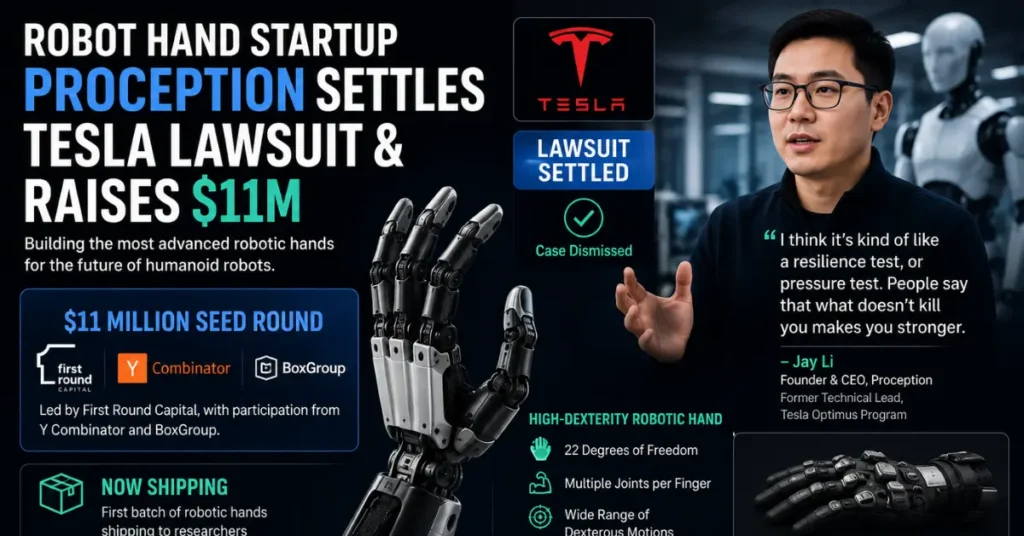
Robotics startup Proception has closed a difficult chapter in its young history by settling a trade secret lawsuit with Tesla. At the same time, the company announced an $11 million seed funding round, giving it fresh momentum as it works to build robotic hands that can closely replicate human movement.
The funding round was led by First Round Capital, with participation from Y Combinator and early-stage investment firm BoxGroup. Alongside the investment, Proception revealed it has begun shipping the first batch of its high-dexterity robotic hands to researchers and robotics companies while opening orders to a wider market.
Tesla Lawsuit Ends With Settlement
Founder and CEO Jay Li, who previously worked as a technical lead on Tesla’s Optimus humanoid robot program, was sued by Tesla last year. The company accused Li of taking trade secrets to launch Proception.
After several months of legal proceedings, both sides reached a settlement earlier this month, leading Tesla to dismiss the lawsuit. Tesla did not comment on the outcome.
Looking back, Li believes the legal battle ultimately strengthened both him and the company.
He described the experience as a “resilience test” and said overcoming the lawsuit helped Proception become more focused as it prepares for its next stage of growth.
Building Better Robotic Hands
Rather than developing complete humanoid robots, Proception is concentrating on one of robotics’ biggest engineering challenges—creating robotic hands capable of performing tasks with human-like precision.
The company aims to become a leading supplier of robotic hands for robotics manufacturers that would rather purchase the technology than spend years developing their own dexterous manipulation systems.
The challenge has received significant attention across the robotics industry. Even Tesla CEO Elon Musk has previously described robotic hands as one of the toughest engineering problems still facing humanoid robots.
While Tesla has suggested Optimus robots could begin working in factories within a few years, many experts believe truly human-like robotic hands remain much further away. Kevin Lynch, director of Northwestern University’s Center for Robotics and Biosystems, previously estimated that it could take around a decade before robotic hands become functional enough to perform many everyday human tasks.
Li believes Proception can significantly shorten that timeline.
Sensor Gloves Power Data Collection
A major advantage of Proception’s approach is how it gathers training data.
Many robotics companies currently rely on teleoperation, where a human operator wearing a virtual reality headset remotely controls a robot. While effective, Li argues this method has limitations because operators cannot fully feel the objects being handled, and data collection depends on the number of robots available.
Proception instead uses specially designed gloves packed with sensors. Human testers wear these gloves together with VR headsets, allowing the company to capture detailed human hand interaction data without requiring a robot during the training process.
The same sensor technology is also built directly into Proception’s robotic hand, effectively acting as electronic skin.
According to the company, the robotic hand features 22 degrees of freedom and multiple joints in each finger, enabling a broad range of highly precise movements that more closely resemble natural human hand motion.
Hardware and Data Working Together
Li believes solving dexterous manipulation requires more than advanced hardware alone.
He argues that scalable data collection is equally important, saying many robotics companies focus heavily on hardware while relying on data collection methods that are difficult to expand.
By combining sophisticated robotic hardware with scalable human interaction data, Proception hopes to accelerate progress toward human-like robotic hands.
Investors See Long-Term Potential
First Round Capital partner Bill Trenchard, who led the investment, said Proception stands out because it is developing both advanced robotic hands and the AI models needed to support them.
According to Trenchard, dexterous manipulation represents one of the final hurdles preventing humanoid robots from becoming truly useful across a wide range of industries.
He also praised Li for remaining focused throughout Tesla’s lawsuit, noting that the founder was transparent with investors from the beginning and demonstrated strong leadership during a challenging period.
Li remains confident about Proception’s future. After overcoming a legal battle with Tesla, he even suggested that one day the electric vehicle giant could become one of Proception’s customers as demand for advanced robotic hands continues to grow.
Also read : Robotaxi Startup Aseon Labs Raises $10M to Cut Costly Empty Miles