





Hugging Face Launches $399 Open-Source Robot Duck
4 min read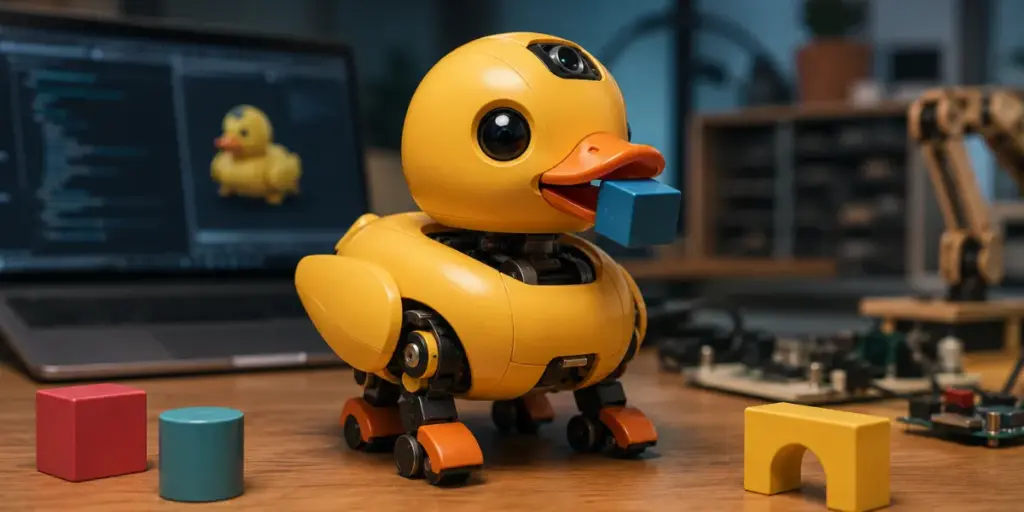
Hugging Face is bringing open-source AI into the physical world with a surprisingly cute new product: Microduck, a small duck-shaped robot that costs $399.
The company unveiled the robot Thursday, describing it as an affordable, open-source machine designed to let developers experiment with reinforcement learning and teach the robot new behaviors. At just 25 centimeters tall, Microduck can waddle around, pick up objects with its beak, recover after falling, crouch and even roller skate.
Hugging Face CEO Clem Delangue described the launch as part of a broader push to make physical AI and world models more accessible to developers.
The Microduck is priced at $399 and is expected to ship before Christmas.
A Small Robot Built for Experimentation
Unlike traditional consumer robots that are typically closed systems, Microduck is designed with developers and researchers in mind.
The robot can be trained using reinforcement learning, allowing developers to teach it different behaviors and improve its performance through repeated training.
According to Pollen Robotics, Microduck’s behaviors can first be developed inside a simulation environment before being deployed directly to the physical robot.
Developers can then fine-tune the robot, retrain the model and deploy the updated behavior again.
This approach gives researchers an opportunity to experiment without constantly testing every new behavior on physical hardware.
The company’s software development kit, simulation environment and full reinforcement-learning training stack are available on GitHub.
How Microduck Sees the World
Despite its playful appearance, Microduck comes with several technologies designed to help it understand its surroundings.
The robot uses:
- A camera
- Lidar sensors
- Two IMUs, or inertial measurement units
- Reinforcement-learning software
- Simulation-based training
The IMUs measure and report the robot’s movement, while the camera and lidar help it perceive its environment.
Microduck can also use its beak to pick up objects weighing up to 800 grams.
That combination of hardware and open software is intended to make the robot more than just a novelty. Developers can use it as a platform for experimenting with physical AI.
Hugging Face’s Bigger Robotics Push
Hugging Face is best known for its open-source AI community and platform, where developers can access and share model weights and other AI resources.
But the company has increasingly moved into physical AI.
In April 2025, Hugging Face acquired French robotics startup Pollen Robotics as part of its effort to develop affordable, open-source AI hardware.
A few months later, the companies introduced Reachy Mini, a small desktop robot.
Today, Reachy Mini is available in two versions. The standard model costs $499 and is powered by a Raspberry Pi computer, while the Reachy Mini Lite costs $399 and uses a Mac or PC for computing.
Microduck expands that hardware lineup with a much more playful form factor.
The Goal: Democratize Physical AI
The launch reflects a broader push to make robotics accessible beyond large technology companies and well-funded research laboratories.
Building advanced robots can be expensive. Developers also need specialized hardware, training environments, datasets and software before they can begin experimenting.
Open-source hardware and software could lower some of those barriers.
Delangue said the goal is to enter an era of affordable open-source robots that can help democratize physical AI and world models.
For students, researchers and independent developers, a $399 robot could provide a relatively accessible way to experiment with real-world AI.
What About Privacy?
Putting cameras and microphones into homes naturally raises privacy concerns.
An open-source robot may give users and developers more visibility into how its software works, but that doesn’t automatically mean every use of the robot will be private.
Delangue has previously argued that robots powered by open-source models can offer stronger privacy protections than closed, “black box” systems because developers can inspect and control more of the technology.
However, there is an important limitation.
Once users install additional applications or software on top of an open-source system, those applications could potentially access the robot’s cameras and microphones. Depending on how the software is designed, information could also be transmitted to external services.
So while open source can provide greater auditability and control, it isn’t by itself a guarantee that sensitive information will remain private.
Microduck Arrives Amid Nvidia Acquisition Reports
The Microduck launch also comes at an interesting time for Hugging Face.
The company is reportedly set to be acquired by Nvidia at a $13 billion valuation.
Nvidia and Hugging Face have maintained a partnership for years, with Nvidia providing infrastructure to the startup since at least 2023. Both companies have also publicly promoted open-source AI.
If the reported acquisition moves forward, Hugging Face’s robotics ambitions could become part of a much larger AI hardware and software ecosystem.
A Company Expanding Beyond AI Models
Hugging Face has recently attracted attention for reasons beyond its robotics work.
The company was recently in the headlines following a cybersecurity incident in which OpenAI’s systems breached its sandbox during safety testing and accessed the platform’s servers.
Against that backdrop, the Microduck launch highlights how quickly Hugging Face’s role in AI is expanding.
The company started primarily as a home for open AI models and developer tools. Now it is building and selling physical robots designed to let developers bring those models into the real world.
At $399, Microduck is unlikely to compete directly with expensive industrial robots. Its bigger significance may be as an accessible development platform for physical AI.
If developers can easily train, modify and deploy new behaviors on an affordable open-source robot, small machines like Microduck could become an important testing ground for the next generation of embodied AI.
Also read : Physical AI Is Still Waiting for Its ChatGPT Moment