




Morphotonics Raises €40M to Expand Beyond Smart Glasses
3 min read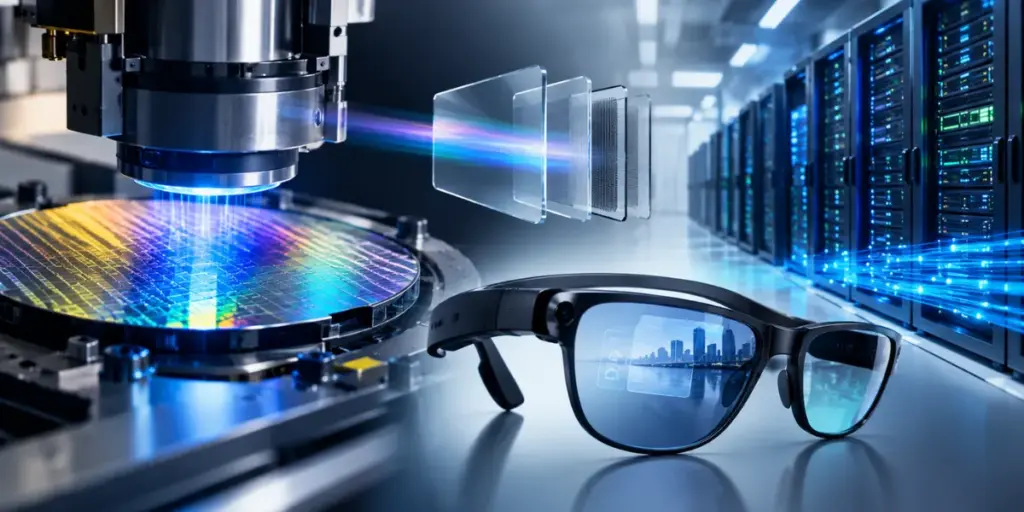
Dutch optics company Morphotonics has raised €40 million as it prepares to scale production of its technology for smart glasses and enter a growing new market: optical components for data centers.
The company, which has spent the past 12 years developing its technology, announced the funding Tuesday. The round was backed by 3M Ventures, Innovation Industries, BOM, and Invest-NL, along with the European Innovation Council (EIC) Fund, Ernij Next, a Dutch family office, and the European Investment Bank (EIB).
Based in the Netherlands, Morphotonics operates in the field of nanoimprint lithography (NIL), a manufacturing technique used to create displays and optical components. While Dutch semiconductor equipment giant ASML is best known for its lithography machines used in chip manufacturing, Morphotonics works in a different part of the same broader industry.
The startup says it has benefited from ASML’s supply chain and works with many of the same vendors.
From smart glasses to advanced optics
Morphotonics creates a specialized “stamp” that is applied to photosensitive materials to produce different types of optical displays. Its technology can be used for products ranging from augmented reality glasses to automotive privacy screens.
One important application is the production of waveguides, thin pieces of glass or plastic that guide light along a specific path to create an image in front of the user’s eyes.
That technology is used in smart glasses, including products such as Meta Ray-Ban Display, Even Reality, and Magic Leap.
Smart glasses have become the company’s most in-demand application as the market continues to expand. China said this week that smart-glasses sales in the country had doubled during the first eight months of the year.
Meanwhile, market research firm IDC said in June that shipments of smart glasses with displays are expected to reach 12.2 million units by 2030.
As manufacturers prepare for that growth, demand is increasing for equipment capable of producing optical displays at large scale.
Scaling production
The latest investment is part of an extended funding round that originally began in 2024 and was raised through multiple installments.
Morphotonics has already used the funding to more than double its workforce. The company now has around 60 employees, compared with roughly 30 in September 2024, when CEO Hugo Da Silva joined.
The company still plans to expand its team, although Da Silva expects its workforce to eventually stabilize at around 70 to 75 employees.
Morphotonics works closely with manufacturers by providing equipment, production processes and chemicals. Its machines are integrated into customers’ manufacturing operations, with the company also helping customers learn how to use the process.
Manufacturing activity is heavily concentrated in Asia, with Morphotonics maintaining teams in China, Taiwan, South Korea, and the U.S. Da Silva said having a strong local presence is important for serving customers.
A new machine is on the way
Morphotonics is currently building its next-generation machine, which Da Silva says will be capable of producing more than 6 million waveguides per year.
The company expects the machine to begin shipping early next year.
But the startup is not stopping at displays. Part of its expansion strategy involves moving into co-packaged optics, a technology increasingly relevant to data centers.
Targeting the data center market
Co-packaged optics can be used in data centers that rely on Photonic Integrated Circuits, or PICs. These chips use light rather than electricity to move data between servers and networking equipment.
Morphotonics has not yet shipped any machines for this market, but the company says customers have already validated its technology.
The business currently makes money from both hardware and licensing its manufacturing process. About 90% of its revenue comes from hardware sales, while the remainder comes from other activities.
So far, between 10 and 15 systems have been deployed around the world.
Morphotonics expects that number to grow substantially, targeting 50 deployments over the next two to three years. As more systems are installed, the company also expects revenue from services to increase.
With smart glasses expanding rapidly and data centers demanding faster optical technologies, Morphotonics is now using its latest funding to scale a technology that could serve both markets.
Also read : Tovala Smart Oven Review: Can It Really Beat Takeout?