




600-Mile EV Road Trip Shows Fast Charging Has Come a Long Way
4 min read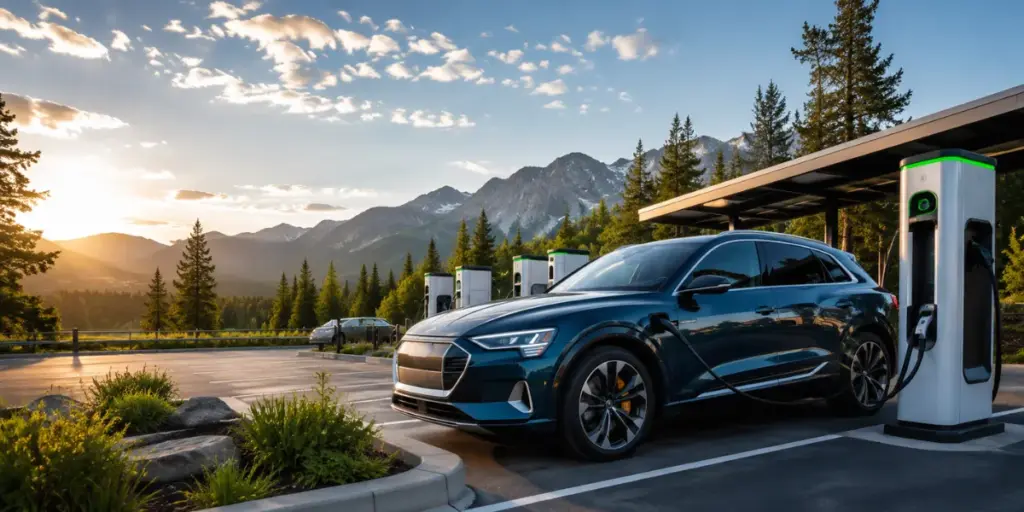
For many people considering an electric vehicle, charging remains one of the biggest concerns. According to a survey conducted by AAA last year, more than half of respondents said the availability of public charging infrastructure plays a major role in their decision about buying an EV.
Those worries are understandable. Public fast charging has long been criticized for unreliable stations, broken chargers, and frustrating road trip experiences. In fact, after a particularly difficult EV journey in 2023, one driver even proposed an unofficial “EV fast-charging bill of rights,” calling for charging networks to improve reliability, accessibility, and overall customer experience.
Just a few years later, the situation appears to have changed dramatically.
A recent road trip covering more than 600 miles between the United States and Montreal highlighted just how much public EV charging has improved. Aside from one minor issue, every charging stop worked as expected, making the trip surprisingly smooth.
Originally, the plan was to travel in a Kia EV9, which offers close to 300 miles of driving range on a full charge. However, with the SUV temporarily in the repair shop due to a faulty air conditioner, the journey was completed in an Audi e-tron instead. Although the e-tron delivers a shorter driving range of roughly 220 miles per charge, it handled the long-distance trip comfortably, showing that having the highest possible range isn’t always necessary for road travel.
To plan charging stops, the driver relied on A Better Routeplanner (ABRP), an app designed to calculate the most efficient charging schedule by considering factors such as weather conditions, battery health, vehicle specifications, and even wind direction. While the app can receive live vehicle data through a Bluetooth OBD reader, it performed accurately without one.
The first recommended stop was a Rivian Adventure Network charging station near Lebanon, New Hampshire. Although ABRP is now owned by Rivian, the recommendation proved worthwhile. The location featured six operational 300-kilowatt chargers, no waiting lines, nearby restaurants, and a grocery store. Even better, payment was simple. Instead of requiring a dedicated app, the charger accepted a standard credit card and delivered charging speeds above 140 kilowatts, close to the Audi e-tron’s maximum charging capability. The same station was used again during the return journey, producing another smooth experience.
The only inconvenience during the trip happened at a Circuit Électrique charging station outside Montreal. The charger itself worked properly, but its credit card reader did not. To begin charging, the driver downloaded the Circuit Électrique mobile app and added 20 Canadian dollars to the account. Once that was completed, the charging session continued without any additional problems.
Looking back, the stop wasn’t even essential because the hotel offered reliable EV charging throughout the stay. Still, the break gave the children a chance to stretch while providing time for coffee, making it a useful stop regardless.
Each charging session lasted approximately 20 minutes, with charging taking place during meal or rest breaks. At no point did the family have to sit around waiting for the vehicle to finish charging. In total, all three charging sessions consumed about the same amount of time as waiting at U.S. border control during the return trip.
The experience was a sharp contrast to a similar road trip completed three years earlier.
In 2023, the same Audi e-tron traveled about 350 miles on a round trip to Maine. Although the vehicle had enough range to reach the destination, the hotel lacked EV charging facilities, making a mid-trip fast charge necessary. Despite carefully selecting stations through ABRP, the journey turned into a frustrating experience. One charger failed shortly after charging began, forcing a move to another stall. Because the original charging session remained active, customer service had to manually end it before another charger would work. Later, another charging location reported two functioning chargers through its app, but only one was actually operational. During roughly seven hours of driving, customer support had to be contacted three separate times.
Fortunately, recent data suggests those kinds of experiences are becoming less common.
According to the Joint Office of Energy and Transportation, the United States had around 32,000 DC fast chargers in July 2023. At that time, a significant portion of the network was limited to Tesla owners. Although Tesla announced plans to open its Supercharger network in 2023, widespread access for non-Tesla vehicles took more than a year to become available.
Today, most of Tesla’s charging network is accessible to a much wider range of EV drivers. Combined with continued expansion from Tesla and other charging providers, the number of available DC fast chargers has more than doubled since 2023.
Reliability has improved as well.
Research from Paren shows that the reliability of U.S. fast-charging stations has increased by nearly 10 percentage points since last year, climbing from about 85% to the mid-90% range. The company’s reliability index measures successful charging sessions along with station downtime. While Tesla continues to lead in charging performance, competing networks have made significant progress, creating stronger competition and better service for EV drivers.
Challenges still remain. Some charging gaps exist, and equipment failures continue to happen. However, new charging stations are being added regularly, and repairs are being completed much faster than they were only a few years ago.
Although the EV charging network is not yet perfect, recent real-world experience and industry data point to meaningful progress. For drivers who have been hesitant about switching to an electric vehicle because of charging concerns, today’s public charging infrastructure offers a far more dependable experience than it did just a few years ago.
Also read : DoorDash Launches Drone Delivery Unit After FAA Approval