




Apollo Atomics Shrinks a Key Part to Cut Nuclear Power Costs
3 min read
The race to make nuclear energy cheaper is attracting billions of dollars and a growing number of startups. Many are working on advanced reactor designs, hoping to make nuclear power more affordable and easier to deploy. But Apollo Atomics believes the industry may be focusing on the wrong piece of the puzzle.
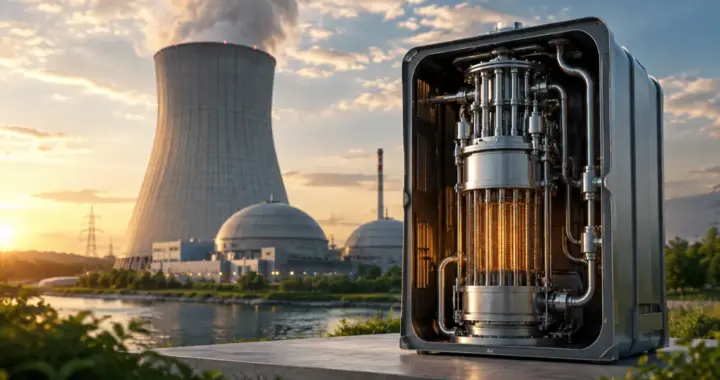
Rather than creating an entirely new reactor, Apollo is targeting one of the biggest components inside a nuclear power plant: the steam generator.
Founded by Assil Halimi and Drew Walker, Apollo Atomics is developing a much smaller steam generator designed to transfer heat more efficiently. Halimi, the company’s CEO, told TechCrunch that shrinking this component could make the entire nuclear power system dramatically more compact.
Steam generators play an essential role in nuclear plants. They take heat from the reactor’s coolant system and use it to produce steam, which then powers a turbine to generate electricity. Traditional steam generators are often custom-built and can stretch several stories in height.
Apollo’s design takes a very different approach. The company says its steam generator is roughly the size of a person and can be mass-manufactured. Because of its smaller footprint, Apollo says it has been able to design a reactor that is about 40 times smaller than a system using a conventional steam generator.
The startup is now preparing to build a demonstration reactor ahead of a planned commercial deployment in 2028. To support that effort, Apollo recently raised $26 million in seed funding, including $5 million in debt. Its technology is based on research conducted at MIT.
Apollo has ambitious cost targets. Halimi estimates that its power plants could eventually generate electricity for about 3 cents per kilowatt-hour. The company is not simply aiming to make nuclear power slightly cheaper than existing designs. Its goal is to compete directly with natural gas.
According to Halimi, conventional steam generators have not evolved enough to take full advantage of nuclear fuel’s extremely high energy density. Many existing designs are based on systems originally developed for coal and natural gas plants, even though nuclear fuels such as uranium contain significantly more energy.
Apollo’s approach uses a compact block of metal containing extremely thin channels. Instead of moving reactor coolant through large tubes surrounded by water, the company’s design places the two fluid loops close together. The smaller channels are intended to improve heat transfer, allowing the steam generator to deliver the same function in a much smaller package.
That smaller size could also change how Apollo nuclear plants are built. Instead of assembling large components at a power plant site, Apollo plans to manufacture the reactor and steam generator inside a factory and then transport them for deployment. The company believes factory production could reduce both construction time and labor costs.
Halimi expects Apollo could build a 300-megawatt power plant in less than 24 months. He also predicts that the reactor itself could cost four to five times less to manufacture than existing reactor designs.
The company has already demonstrated its technology with a small 40-kilowatt reactor built at MIT. Apollo plans to eventually offer three reactor sizes, ranging from 10 megawatts-electric to 300 megawatts.
Apollo’s latest funding round was led by FCVC, with participation from Telesoft Partners, Y Combinator, Alumni Ventures, Robinhood Ventures, Nucleation Capital, Pelion VC, Duke Capital Partners, New Era Ventures, Orange Collective, Stanford University, E14 Fund and Neutron Power Ventures.
Apollo was also part of Y Combinator’s Spring 2026 batch.
The company’s strategy highlights a different path for the nuclear industry: instead of completely redesigning the reactor, make one overlooked but critical component dramatically smaller, more efficient and easier to manufacture. Whether that approach can ultimately deliver nuclear power at a price competitive with natural gas will become clearer as Apollo moves from its demonstration system toward commercial deployment.
Also read : Amazon Makes Alexa+ Free on Fire TV Without Prime