





Pacific Fusion Breaks Ground on New Fusion Power Facility
3 min read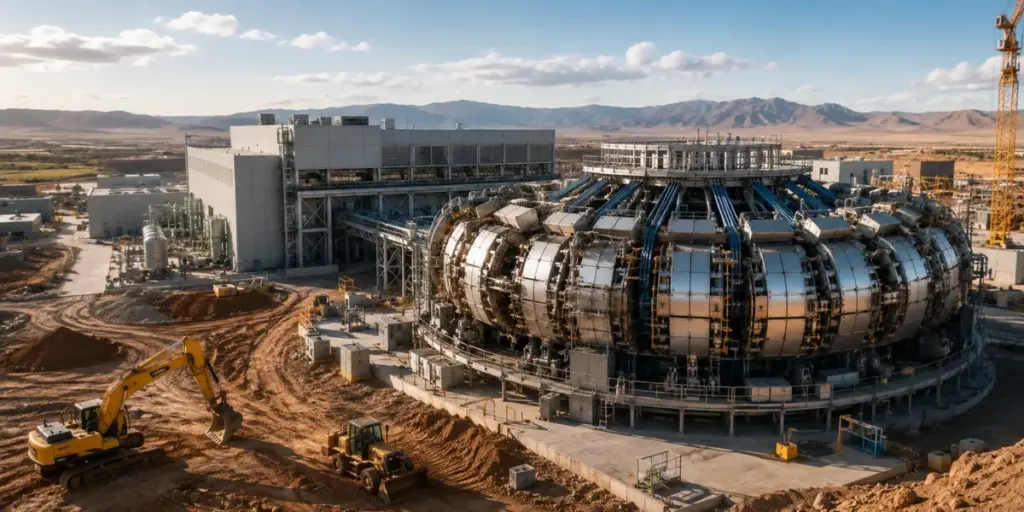
Pacific Fusion is taking another major step toward commercial fusion power, breaking ground on a new facility in Albuquerque, New Mexico, that is designed to achieve a milestone the industry has yet to reach: generating enough energy to cover the energy consumed by the facility itself.
The company began construction Tuesday on the demonstration facility, which Pacific Fusion hopes will achieve “net facility gain” by 2030. The milestone could represent an important step toward the company’s longer-term goal of operating a commercial fusion power plant in the mid-2030s.
“It’s a huge step forward for commercial fusion power,” said Carrie von Muench, Pacific Fusion’s co-founder and chief operating officer, noting that, to the company’s knowledge, no similar facility is currently being constructed in the U.S.
Fusion companies have made significant advances in recent years, but producing more fusion energy than the entire facility consumes remains a major challenge. The National Ignition Facility has demonstrated that controlled fusion reactions can produce more energy than the reactions themselves consume, but its overall energy output is still far below what would be required to power the facility.
Pacific Fusion is attempting to tackle that larger challenge.
A different approach to fusion
The Albuquerque facility will test the company’s fusion technology, which relies on powerful and precisely timed bursts of electricity. Those electrical pulses create an intense magnetic field around a tiny fuel target roughly the size of a pencil eraser.
The magnetic field compresses the fuel until its atoms fuse, releasing energy in the process.
The demonstration system is expected to perform several “shots” each day, according to Keith LeChien, Pacific Fusion’s co-founder and chief technical officer. That frequency will eventually need to increase dramatically. A commercial-scale fusion power plant would need to perform roughly one shot every second.
To generate the massive electrical pulses, the facility will use 156 pulser modules. Each module contains 32 circular stages, with every stage consisting of 10 bricks. Each brick contains two capacitors for storing electrical energy and a switch used to release it.
Pacific Fusion has already tested a one-third-scale version of one of these pulser modules. Earlier this year, the test system delivered 440 gigawatts of peak power in just 80 nanoseconds. The results helped clear the way for construction of the larger demonstration facility.
More than a fusion power test
The new campus will have another role beyond demonstrating net facility gain. Pacific Fusion plans to use the site for national security-related experiments involving high-yield fusion.
The U.S. already operates facilities for similar research, including the National Ignition Facility, but that facility is beginning to age. Pacific Fusion says its new system could produce around 100 megajoules with each pulse, according to LeChien — roughly 10 times the output of the National Ignition Facility.
“This exists nowhere in the world,” LeChien said. “China is building these types of facilities, and we intend to be the first to deliver them.”
If successful, the demonstration facility would still be only one step toward a commercial reactor. Pacific Fusion expects its full-scale power plant to produce about five times more energy than the demonstration system, partly because a commercial plant will require additional equipment and energy to operate.
A heavily funded race
Pacific Fusion was founded in 2023, making it one of the newer companies competing in the fusion industry. Despite its relatively short history, the startup has attracted substantial financial backing, raising more than $1 billion through a milestone-based Series A round.
The large funding round has allowed the company to plan further ahead instead of returning to investors for new funding every few years, von Muench said.
That financial runway could prove valuable as Pacific Fusion races toward its commercial target. The fusion industry has attracted several other well-funded startups, including Commonwealth Fusion Systems, Helion Energy, Proxima Fusion and Inertia Enterprises.
Many of these companies are targeting the same broad goal: putting a fusion power plant on the electrical grid by the mid-2030s or sooner.
For Pacific Fusion, the newly launched Albuquerque facility is intended to provide a crucial test of whether its technology can move beyond producing fusion reactions and toward the much harder task of producing enough energy to support an entire facility.
Also read : General Motors EV Brake Problems Face Tougher Federal Investigation