





Why EOR Hiring Can Drain Startup Budgets
3 min read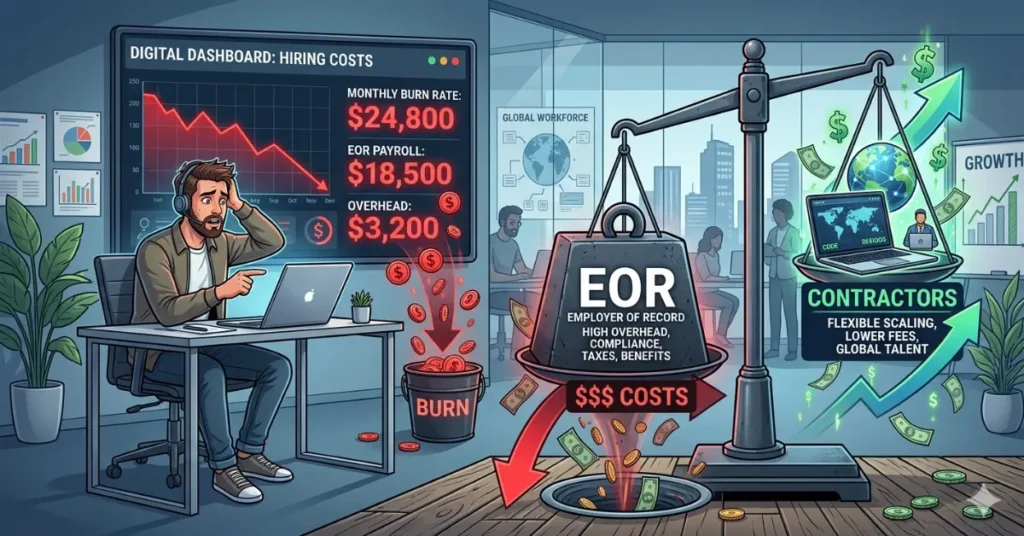
Startups don’t usually fail because of bad ideas—they fail because they run out of money. And one overlooked reason behind that cash burn? Overspending on hiring.
Many founders turn to Employer of Record (EOR) services, assuming full-time hiring is the safest and most scalable way to build a team. But in reality, this approach can slow companies down and quietly inflate costs—sometimes to a dangerous level.
The hiring myth startups believe
The traditional mindset is simple: hire full-time employees to grow faster. But in today’s fast-moving startup world, that approach doesn’t always hold up.
To scale effectively, startups need to focus on three things:
- Getting work done efficiently
- Moving quickly
- Keeping costs under control
EOR services, while useful in certain cases, often struggle to deliver on all three.
Where EOR falls short
The biggest issue? Speed.
Hiring through an EOR isn’t instant. The process involves compliance checks, onboarding steps, and contract finalization—which can take weeks or even months. For startups operating in fast-changing markets (especially with AI reshaping industries quickly), that delay can be costly.
Compare that to hiring a contractor, which can often be done in just a couple of days.
Then there’s the issue of control. When using an EOR, the startup doesn’t directly employ the worker. That can create limitations around intellectual property rights, work terms, and flexibility—especially in countries with strict labor laws.
In regions like Brazil or Spain, where employee protections are strong, letting someone go can turn into a long and expensive legal process. Add to that the ongoing cost—around $599 per employee per month—and the financial strain becomes clear.
A more flexible alternative
Instead of defaulting to EOR, many startups are now exploring contractor-based models.
Solutions like contractor management services or Contractor of Record (COR) offer a different path. These options allow startups to onboard talent quickly, reduce administrative overhead, and maintain flexibility.
The cost difference is significant too. Contractor platforms typically range between $39 and $70 per month—far lower than EOR fees.
For early-stage startups, especially at the seed or Series A level, this flexibility can be a game-changer.
When EOR still makes sense
That said, EOR isn’t useless—it just isn’t always the right default choice.
It can be helpful when:
- A candidate specifically wants full-time employment with benefits
- You’re hiring a long-term, critical team member
- You’re setting up operations in a new country with long-term plans
In these cases, the structure and compliance support of an EOR can be valuable.
The bigger picture
The modern startup playbook is evolving. Founders are realizing that full-time hiring isn’t the only way to build a strong team—and in many cases, it’s not the most efficient one either.
Flexible workforce models are becoming more attractive, especially in a world where speed and cost control can determine survival.
Final takeaway
Startups that rethink hiring strategies early have a better chance of scaling sustainably. By avoiding unnecessary overhead and embracing flexible talent solutions, they can extend their runway—and improve their odds of success.
In a competitive market, that difference isn’t small. It can be everything.
Also read : Iran-Linked Hackers Claim FBI Chief Email Breach