


AI Backlash Grows as Search, Jobs, and Tech Leaders Clash
3 min read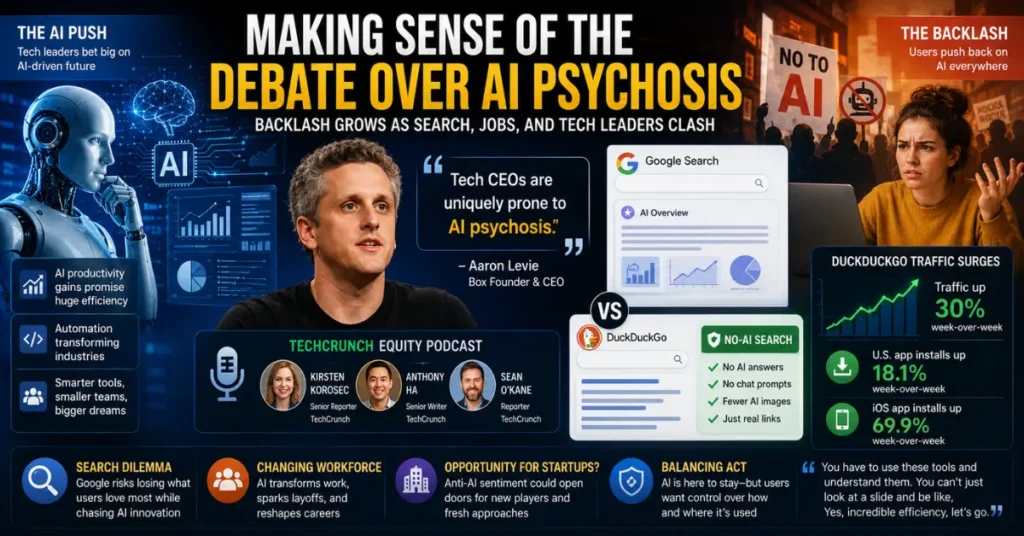
Artificial intelligence continues to dominate the tech industry, but a growing debate suggests not everyone is convinced that more AI automatically means better products or better experiences.
The discussion gained fresh momentum after Box CEO Aaron Levie remarked that tech leaders may be “uniquely prone to AI psychosis,” a comment that sparked conversations across the technology world. While Levie was not arguing against AI itself, he suggested that executives can sometimes become overly optimistic about the technology without fully understanding the practical work still required to generate real value.
The topic became a major focus on a recent episode of TechCrunch’s Equity podcast, where hosts explored the widening gap between AI enthusiasts and those becoming increasingly skeptical of the technology’s rapid expansion.
One of the clearest examples of this divide can be seen in online search.
Google recently unveiled a major AI-driven transformation of its search engine, introducing more AI-generated overviews, interactive results, and conversational experiences. The company believes these features will make search more useful and productive. However, some users appear less enthusiastic about the shift.
According to discussions highlighted on the podcast, alternative search engines are benefiting from the growing discomfort around AI-heavy search experiences. Privacy-focused search engine DuckDuckGo recently reported a sharp increase in traffic and app installs after Google announced its latest AI-focused search changes.
While Google remains the dominant player in search, the rise in interest toward alternatives suggests there is a sizable audience that still prefers traditional search results. Many users continue to value the familiar experience of receiving straightforward links rather than AI-generated summaries and chat-style responses.
The debate extends beyond search engines. Some industry observers believe Google faces a difficult balancing act. On one hand, it must innovate to remain competitive in the rapidly evolving AI race. On the other hand, it risks changing the very product that made users trust the brand in the first place.
Critics argue that Google’s strength has always been information retrieval. As the company places greater emphasis on AI-powered shopping tools, visualizations, and conversational search, some users worry that the core search experience is becoming less reliable.
The conversation also highlighted how different technology companies are approaching AI. Some firms are aggressively adding AI features to nearly every product, while others are taking a more focused approach, carefully defining where AI adds value and where it does not.
At the same time, the impact of AI on the workforce remains a growing concern. Layoffs across parts of the tech industry have intensified discussions about whether AI is replacing certain tasks or fundamentally changing how people work.
Industry observers note that many executives and investors are excited by the possibility of smaller teams achieving the output once expected from much larger organizations. However, critics argue that these expectations can become unrealistic if leaders rely on presentations and projections rather than hands-on experience with AI tools.
Supporters of AI point out that the technology is already improving productivity across coding, automation, robotics, manufacturing, and many other sectors. Yet skeptics believe the current hype cycle may be encouraging companies to move too quickly without fully understanding the limitations.
What is becoming increasingly clear is that public opinion on AI is far from settled. While millions of people use AI-powered tools every day, a growing number are actively seeking alternatives that prioritize traditional experiences. This tension is creating new opportunities for startups, search engines, and businesses willing to serve users who want more control over how much AI appears in their daily lives.
As the technology continues to evolve, the debate is likely to remain one of the most important conversations shaping the future of the internet and the workplace.
Also read : Final Hours to Apply as a Speaker at TechCrunch Disrupt 2026