



Scholly Founder Sues Sallie Mae Over Data and Firing Claims
3 min read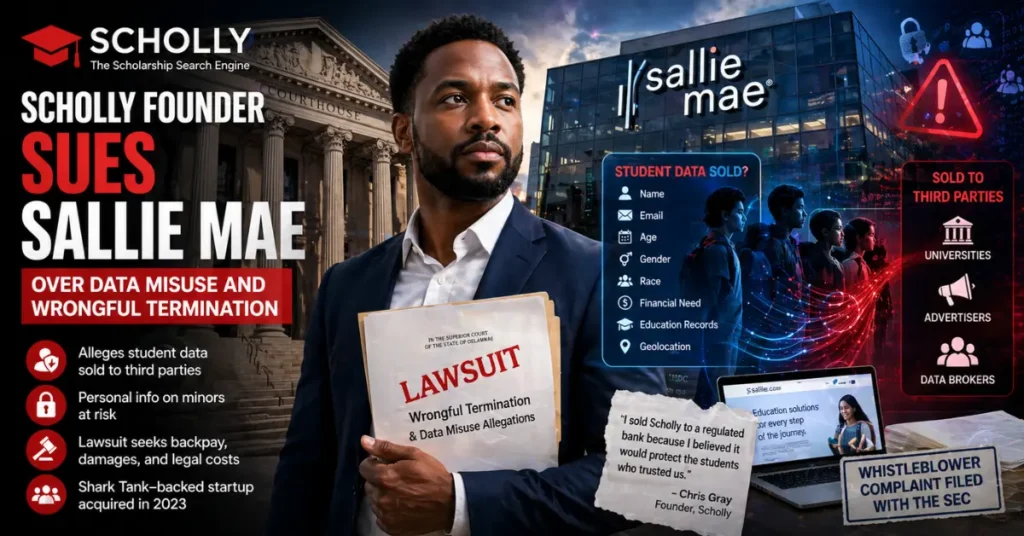
The founder of a popular scholarship app is taking his former acquirer to court, raising serious questions about data privacy and corporate conduct.
Chris Gray, the entrepreneur behind the scholarship platform Scholly, has filed a lawsuit against Sallie Mae, accusing the firm of wrongful termination and misuse of user data. The legal battle comes less than two years after Sallie Mae acquired Scholly in 2023.
From Big Exit to Legal Fight
Gray, who built Scholly to help students find untapped scholarship opportunities, rose to prominence after securing backing from investors like Daymond John and Lori Greiner on the TV show Shark Tank. The startup grew rapidly, eventually reaching around 5 million users and generating over $30 million in revenue.
When Sallie Mae acquired the company, Gray stepped into a vice president role, expecting to scale the platform and expand access by making it free for users. At the time, he described the deal as a milestone—especially as one of the few Black venture-backed fintech founders to achieve a successful exit.
But according to Gray, things quickly took a different turn.
Allegations of Data Misuse
In filings submitted to Delaware Superior Court and a whistleblower complaint to the SEC, Gray claims Sallie Mae went back on key promises made during the acquisition.
He alleges the company laid off much of the original Scholly team, including his co-founders, and later began exploring ways to sell user data—despite earlier assurances that such practices would not occur.
Gray says he believed Scholly users would be protected under strict financial regulations once the company was acquired by a federally regulated bank. However, he now claims Sallie Mae created a separate entity—SLM Education Services—to bypass those restrictions.
According to the complaint, this subsidiary allegedly sells sensitive user data, including age, gender, race, financial need indicators, and more, to third parties such as universities, advertisers, and data brokers.
“I sold Scholly to a regulated bank because I believed it would protect the students who trusted us,” Gray said. “Instead, I watched the company build a non-bank subsidiary to do things the bank itself can’t legally do.”
Firing and Fallout
Gray also alleges that he was fired in 2024 after raising concerns internally about potential data privacy issues. He claims he was dismissed just before a planned meeting with CEO Jon Witter where he intended to escalate those concerns.
He is now seeking back pay, legal costs, and punitive damages.
Sallie Mae has strongly denied the accusations. A company spokesperson described the claims as “without merit” and said it plans to defend itself vigorously in court. The firm declined to provide further details about its data practices.
Concerns Over User Transparency
Part of Gray’s complaint centers on a website called “Sallie.com,” which operates separately from Sallie Mae’s main banking platform. He argues that the branding and layout could confuse users into thinking they are interacting with a regulated financial institution.
The site’s privacy policy states that it may share or sell user data—including personal and educational details—with third parties.
Gray also alleges that this data may have been used to build a marketing platform called Backpack Media, aimed at targeting younger audiences like Gen Z and Gen Alpha.
A Mission Rooted in Access
Gray’s journey started in Birmingham, Alabama, where he grew up in a low-income household. After personally securing around $1.3 million in scholarships—including support from organizations like the Bill and Melinda Gates Foundation—he set out to simplify the scholarship search process for others.
That mission led to the creation of Scholly in 2013, a platform built to match students with opportunities based on key criteria like GPA, location, and financial need.
Despite the current legal dispute, Gray says he does not regret selling the company, as it helped make the platform free for students.
Still, he stands by his decision to speak out.
“I believe we should live in a system where an executive can raise concerns and help guide a company toward fair and lawful practices,” he said.
As the case unfolds, it could shine a spotlight on how fintech firms handle sensitive user data—especially when it involves younger audiences.
Also read: OpenAI Eyes AI-First Phone to Replace Apps